Chronic Hives: 8 Proven Steps to Control Urticaria for Good
There is a particular exhaustion that sets in around week seven. The welts that felt alarming on day one have become a grim routine. You have cut out foods, changed your washing powder, bought three different antihistamines, and none of it has made the hives stop. You have started to wonder whether anyone actually knows what is going on — or whether you will simply have to live like this.
Here is what you most need to hear at that point: chronic hives are common, they are well understood by specialists, and they are treatable even when no cause is ever found. The frustration you feel is real, but the hopelessness is not warranted. Most people with chronic urticaria get good control once they reach the right step on the treatment ladder — and the usual reason it takes so long is that people never get past the first rung.
Quick Overview
| Question | Short answer |
|---|---|
| What counts as chronic? | Hives lasting six weeks or longer |
| Most common type | Chronic spontaneous urticaria — no identifiable external trigger |
| Underlying mechanism | Often the immune system activating the body’s own mast cells |
| Is a cause usually found? | No, in the majority of cases — and that does not prevent treatment |
| First-line treatment | Daily second-generation antihistamines, dose increased if needed |
| If that fails | Omalizumab injections or ciclosporin under specialist care |
| Typical course | Often resolves on its own within a few years; controllable throughout |
| Is it dangerous? | Usually not, but see a doctor to rule out other causes |
What Are Chronic Hives?
Chronic hives — known medically as chronic urticaria — are raised, itchy welts that keep appearing for six weeks or longer. That six-week line is not arbitrary. It marks the point where the condition stops behaving like a one-off reaction and starts behaving like an ongoing process that needs a different approach.
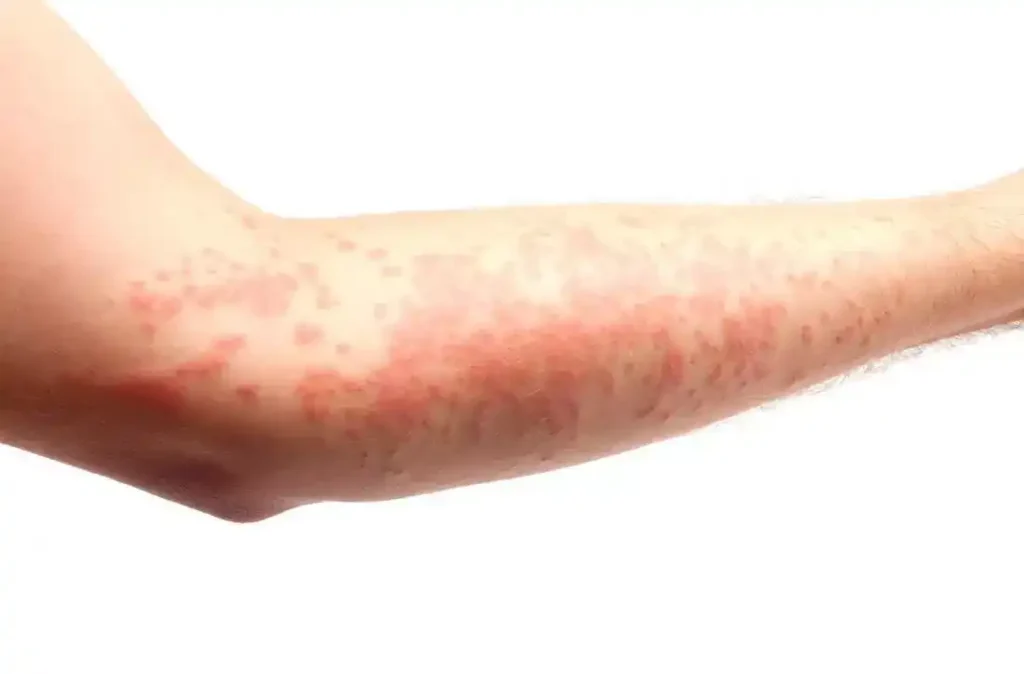
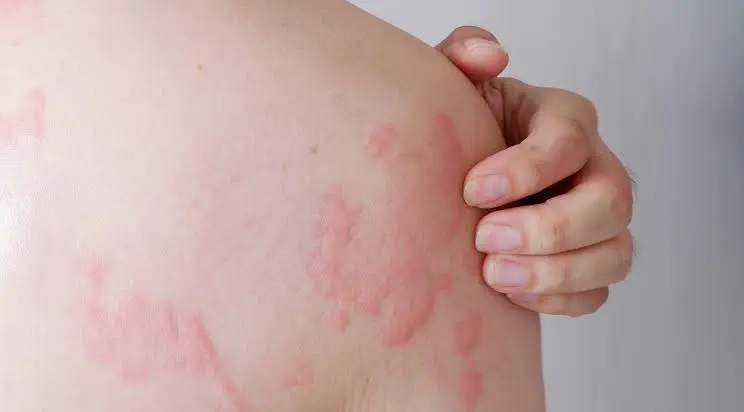
The welts themselves look and feel the same as any hives: raised patches, pink or red on lighter skin and often skin-toned or darker on brown and Black skin, intensely itchy, and blanching pale when pressed. Individual welts still come and go within 24 hours. What defines the chronic form is not the appearance but the persistence — new welts keep forming, day after day, week after week. For the full picture of how hives form in the skin, see our main guide on hives on skin: symptoms, causes, and relief.
There are two broad categories:
Chronic spontaneous urticaria is the more common form. Welts appear with no identifiable external trigger — they simply come and go. This is the type that frustrates people most, because there is nothing obvious to avoid.
Chronic inducible urticaria is reproducibly triggered by a specific physical stimulus: pressure, cold, heat, sunlight, or scratching. Here there is a trigger, but it is a physical one rather than an allergen.
Why Chronic Hives Happen
The single most important thing to understand is that chronic hives are usually not an allergy, which is why allergy testing so often comes back clean and leaves people more confused than before.
In a large proportion of chronic spontaneous cases, the immune system produces autoantibodies that bind to and activate the person’s own mast cells — the histamine-storing cells in the skin. There is no external allergen. The trigger is internal and continuous, which is exactly why the welts appear daily with no discernible pattern.
This autoimmune mechanism explains several things that otherwise seem contradictory:
- Chronic hives cluster with autoimmune thyroid disease
- Standard allergy tests are normal
- The condition often begins after a period of physical or emotional stress
- It can persist for months or years and then resolve on its own
Our detailed guide to what causes hives works through the full range of triggers, but for the chronic form specifically, “no external cause found” is the norm rather than a failure of investigation.
Symptoms and How They Affect Life
Beyond the visible welts, chronic urticaria takes a toll that is easy to underestimate:
- Itching that is frequently worst in the evening and overnight
- Disrupted sleep, week after week
- Deeper swelling of lips, eyelids, hands, or feet — angioedema — in around 40% of people
- Welts appearing where clothing presses
- Fatigue, low mood, and difficulty concentrating
That last group is not incidental. Studies consistently find that chronic urticaria damages quality of life to a degree comparable with serious heart disease, largely through relentless sleep disruption. If your hives are wrecking your rest and your mood, that is a legitimate medical reason to push for better treatment — not something to endure quietly.
How Chronic Hives Are Diagnosed
Most of the diagnosis comes from your history, not from a battery of tests. A clinician will ask how long each welt lasts, when the episodes began, what medications you take, whether swelling accompanies the welts, and whether any physical stimulus reliably brings them on.
For chronic hives, guidelines from dermatology and allergy bodies suggest a limited, targeted set of tests rather than a broad fishing expedition:
- A full blood count
- An inflammatory marker such as CRP or ESR
- Thyroid antibodies, given the strong link with autoimmune thyroid disease
Further testing is driven by specific clues. Broad allergy panels ordered without a matching history are actively unhelpful here — they throw up incidental positives that send people down months of pointless dietary restriction. The American Academy of Dermatology’s hives resource sets out this stepwise approach for patients.
One red flag worth knowing: if individual welts last longer than 24 hours, feel painful rather than itchy, and leave a bruise behind, that points away from ordinary urticaria and towards urticarial vasculitis, which needs a skin biopsy and different treatment.
8 Proven Steps to Control Chronic Hives
This is the core of getting better. These steps follow the evidence-based treatment ladder — most people gain control somewhere along it.
1. Take a second-generation antihistamine every single day. Cetirizine, loratadine, fexofenadine, or levocetirizine — taken daily, not just when welts appear. Chronic hives need continuous receptor blockade to prevent welts from forming.
2. If a standard dose is not enough, ask about increasing it. International guidelines support raising the dose up to four times the standard amount under medical supervision. This is normal practice, not an off-label gamble, and it is where most people who “failed” antihistamines actually succeed.
3. Give each step enough time. Antihistamine adjustments need two to four weeks to show their full effect. Switching too quickly means never knowing what would have worked.
4. Add a second agent if needed. A leukotriene receptor antagonist such as montelukast is sometimes added, particularly if NSAIDs aggravate your hives.
5. Use steroids only as a short rescue. A brief course of oral corticosteroids can break a severe flare, but days, not weeks — long-term steroids carry serious risks and hives often rebound afterwards.
6. Escalate to omalizumab if antihistamines fail. This injected anti-IgE antibody has strong randomised-trial evidence in chronic spontaneous urticaria and has transformed outcomes for people who previously had none. Given monthly under specialist care.
7. Consider ciclosporin for resistant cases. An immunosuppressant reserved for hives that resist even omalizumab, used with monitoring of kidney function and blood pressure.
8. Track and treat contributing factors. Manage stress and sleep, correct vitamin D deficiency if present, avoid NSAID aggravation, and treat any associated thyroid disease. These do not replace the ladder but genuinely improve results. Our guide on how to get rid of hives covers the treatment ladder in even more detail.
Herbal and Natural Support: What the Evidence Shows
These are supportive measures — they reduce discomfort and may lower overall reactivity, but none replaces medical treatment for a condition this persistent.
Vitamin D has the strongest evidence. A randomised controlled trial found that adding high-dose vitamin D3 to standard antihistamine therapy produced significantly greater symptom improvement in chronic urticaria than antihistamines alone. Have your level checked before supplementing at high doses.
Colloidal oatmeal baths reliably ease itch and provide real, low-risk comfort during flares.
Quercetin, a flavonoid in onions, apples, and capers, stabilises mast cells in laboratory studies, but human trials in urticaria remain small. Plausible, unproven; may interact with blood thinners.
Be sceptical of any product promising to cure chronic hives permanently, “detox” protocols, or undisclosed herbal blends — some imported skin creams have been found to contain unlabelled corticosteroids, which is why they appear to work and then rebound badly. Our article on natural remedies and what actually works explains how to judge these claims.
Home Care for Long-Term Hives
- Cool compresses for 10–15 minutes, not ice, to calm itch
- Lukewarm, brief showers — hot water reliably worsens hives
- A cool bedroom around 18°C with light bedding
- Loose cotton clothing to reduce friction
- Short fingernails to limit the damage from scratching
- A plain fragrance-free emollient after bathing
- An evening antihistamine dose to protect sleep
- Timestamped photos of welts to show your doctor
Foods to Eat and Foods to Avoid
Unless you have a confirmed food allergy, diet is a secondary factor — but a supervised low-histamine trial helps a minority.
| Generally well tolerated | Worth reducing during a flare |
|---|---|
| Fresh meat, poultry, fresh fish | Aged cheese, cured and processed meats |
| Rice, oats, quinoa | Fermented foods, soy sauce, vinegar |
| Most fresh vegetables | Tomatoes, spinach, aubergine, avocado |
| Apples, pears, blueberries | Strawberries, citrus, pineapple |
| Oily fish for omega-3s | Alcohol, especially red wine and beer |
| Water, herbal teas | Leftovers stored over 24 hours, additives |
A three-week supervised trial of a low-histamine, additive-reduced diet is reasonable if standard treatment falls short. Indefinite self-restriction without clear benefit is not worth the nutritional and psychological cost.
When to See a Doctor
Book an appointment if:
- Hives have continued beyond six weeks
- Over-the-counter antihistamines at standard doses are not controlling symptoms
- Itching is disrupting your sleep or daily functioning
- Individual welts last more than 24 hours, hurt, or leave bruising
- Hives are accompanied by fever, joint pain, or weight loss
- You have recurrent swelling of the lips or eyelids
Seek emergency care immediately for difficulty breathing, throat tightness, swelling of the tongue or mouth, hoarseness, dizziness, or fainting. Detailed guidance on widespread outbreaks is in our article on hives all over the body.
Final Thoughts
Chronic hives are a marathon, not a sprint, and the people who do best are the ones who keep climbing the treatment ladder rather than stalling on the first step. A daily antihistamine at an adequate dose controls a large share of cases. For the rest, omalizumab has genuinely changed what is possible. And for most people, the condition eventually resolves on its own — often within a few years — even when no cause was ever found.
The mindset shift that helps most is this: with chronic urticaria, the realistic goal is control, not cure, and control is very achievable. If your current treatment is not delivering it, that is not the end of the options — it is a signal to ask your doctor about the next step. The Mayo Clinic overview of chronic hives is a reliable reference to bring to that conversation.
Medical disclaimer: This article is for general information and is not a substitute for professional medical advice, diagnosis, or treatment. Always consult a qualified healthcare provider about your individual circumstances, particularly before changing any medication dose or starting any supplement.
Frequently Asked Questions
How long do chronic hives last? By definition they have already lasted six weeks or more. Many cases resolve on their own within one to five years, though this varies widely. Throughout that time, symptoms can usually be well controlled with treatment.
Are chronic hives an autoimmune condition? In a large proportion of chronic spontaneous cases, yes — the immune system activates the body’s own mast cells. This is why the condition links with autoimmune thyroid disease and why allergy tests are usually normal.
Why won’t my hives go away? Persistent daily welts point away from a simple allergy, which does not run continuously. The usual explanation is chronic spontaneous urticaria, an autoimmune process, or an ongoing physical trigger. The good news is that all of these respond to the treatment ladder.
Can chronic hives be cured? There is no guaranteed permanent cure, but the condition frequently resolves on its own over time and can be very well controlled with treatment in the meantime. The realistic and achievable goal is control rather than cure.
What is the best treatment for chronic hives? A daily second-generation antihistamine is first-line, with the dose increased up to fourfold if needed. When that is not enough, omalizumab injections have strong evidence, followed by ciclosporin for resistant cases.
Does stress make chronic hives worse? Yes. Stress lowers the threshold at which mast cells release histamine and worsens the itch–scratch cycle. It rarely causes chronic hives alone but commonly aggravates them — see our guide on stress hives.
Should I get allergy testing for chronic hives? Only if your history points to a specific exposure. Broad untargeted panels frequently produce misleading positives and unnecessary food avoidance in chronic urticaria.
Are chronic hives dangerous? Usually not, though they significantly affect quality of life. See a doctor to rule out other causes, and seek emergency care if hives ever occur with breathing difficulty or swelling of the tongue or throat.