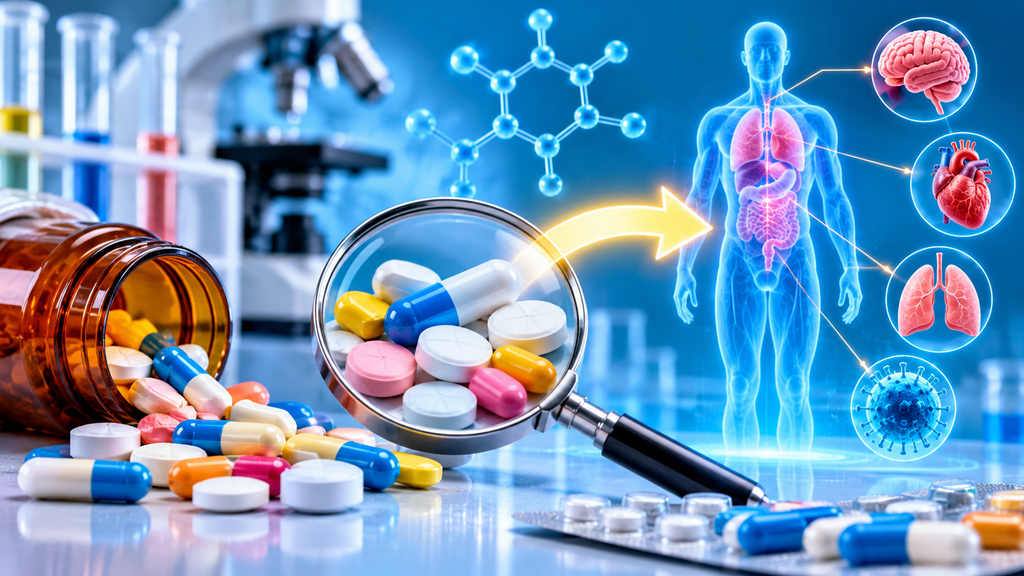
AI in Drug Repurposing is helping researchers find new uses for existing medicines. This process is called drug repurposing. It means studying a medicine to see if it can also help treat another disease.
A drug developed for one condition may have an effect on a different health problem. Researchers use AI to study medical records, genes, proteins, and scientific papers. This helps them find possible links between medicines and diseases.
AI can make this research easier by reviewing large amounts of information. However, an AI prediction does not prove that a medicine will work. Laboratory studies and clinical trials are still needed before a new treatment can be confirmed.

What Is Drug Repurposing?
Drug repurposing is the process of finding a new use for an existing medicine. It is also called drug repositioning.
For example, a medicine developed for one disease may show potential for another condition. Researchers can study this possible use through further testing.
This approach is different from developing a completely new drug. Existing medicines may already have safety information and research data. This gives scientists a useful starting point.
However, approval for one disease does not mean a drug is approved for another. Its safety, dose, and effects must be studied for the new use.
Why Is Drug Repurposing Important?
Developing a new medicine can take years of research and testing. Drug repurposing offers another way to search for possible treatments.
Researchers can study medicines that already exist instead of starting from the beginning. This may help them explore treatment options for diseases with limited choices.
Drug repurposing may help scientists:
- Find possible new uses for existing medicines.
- Study rare diseases with limited treatment options.
- Use earlier research about drug safety.
- Identify medicines for further laboratory testing.
- Explore new directions in medical research.
How Does AI Help in Drug Repurposing?
AI can study large amounts of medical and scientific data. It helps researchers find patterns and possible connections between medicines and diseases.
1. Machine Learning
Machine learning is a type of AI that learns patterns from data. Researchers use it to compare information about drugs and diseases.
A model may find a possible link between a medicine and a disease. It can also rank medicines based on the results. Researchers then decide which options need further study.
2. Deep Learning
Deep learning is a type of machine learning that studies complex data through several layers of computer systems.
Researchers can use it to study genes, proteins, and other biological information. It may help identify patterns linked to diseases and possible drug effects.
3. Natural Language Processing
Natural language processing (NLP) helps computers read and study written information.
Researchers use it to analyze scientific papers, medical reports, and research databases. It can identify information about medicines, diseases, genes, and proteins.
This helps scientists explore findings from many research papers.
4. Biomedical Knowledge Graphs
A biomedical knowledge graph connects information about medicines, diseases, genes, and proteins.
AI can study these connections to find possible new uses for existing drugs. Researchers can then check whether these links are worth investigating.
How Does AI-Powered Drug Repurposing Work?
AI-based drug repurposing usually involves six main steps.
Step 1: Collecting Data
Researchers collect information from different sources, including:
- Scientific research papers
- Electronic health records
- Genetic and genomic data
- Protein databases
- Drug databases
- Clinical research findings
These sources provide information about medicines, diseases, and the human body.
Step 2: Combining Data
Researchers organize information from different sources. They may use multi-omics data, which includes information about genes, proteins, and other biological processes.
Combining these sources helps scientists study a disease from different angles.
Step 3: Finding Drug-Disease Links
AI models study the data to find possible relationships between medicines and diseases.
For example, a model may find that a drug affects a biological process linked to a certain disease. This gives researchers a reason to study the medicine further.
Step 4: Ranking Drug Candidates
AI systems can score and rank possible medicines. This helps researchers compare candidates and select those that may deserve more attention.
A high score does not mean that a medicine will work. It is only a prediction.
Step 5: Laboratory Testing
Researchers test promising medicines in laboratories. These studies may include cell-based experiments and animal studies.
The aim is to check whether the medicine has the expected effect and whether further research is useful.
Step 6: Clinical Trials
If laboratory results support further research, the medicine may be studied in clinical trials.
These trials help researchers check its safety and effectiveness in people. Regulatory review may also be needed before the new use is approved.
Applications of AI in Drug Repurposing
AI can support research into several types of diseases.
Cancer Research
Cancer involves changes in cells, genes, and biological processes. AI can study this information and help researchers find existing medicines that may affect cancer-related processes.
These results can guide further research. They do not prove that a medicine can treat cancer.
Neurological Diseases
Researchers are using AI to study conditions such as Alzheimer’s disease.
One area of research has explored sildenafil as a possible candidate for Alzheimer’s disease. Laboratory experiments using neurons made from patient cells reported changes in phosphorylated tau 181 after sildenafil treatment.
This is a laboratory finding, not proof that sildenafil treats Alzheimer’s disease in people. Further research is needed.
Infectious Diseases
AI can help researchers study medicines that may affect viruses, bacteria, and other infectious agents.
It can compare drug information with data about infections. This may help identify medicines for further testing.
Rare Diseases
Rare diseases often have limited research and treatment options. AI can connect information from scientific papers, patient records, and biological databases.
These connections may help researchers identify existing medicines that are worth studying.
Real-World Research in Drug Repurposing
Organizations such as Every Cure are exploring new uses for existing medicines. Their work uses biomedical data, knowledge graphs, and machine learning to find possible links between drugs and diseases.
Experts review these findings before deciding which medicines need further research.
One reported example involves lenalidomide combined with dexamethasone for Rosai-Dorfman disease. This example has been discussed in research and treatment guidance for suitable patients.
Such examples show how existing medicines may have uses beyond their original purpose. However, researchers must still consider the disease, patient group, dose, and safety risks.
Benefits of AI in Drug Repurposing
AI offers several possible benefits for medical research.
Faster data analysis: AI can review large amounts of scientific information and find patterns.
Better research planning: It can rank possible drug candidates and help researchers choose which medicines to study.
Use of existing research: Some medicines already have safety and toxicity information from earlier studies.
Support for rare diseases: AI can connect information from different sources to find possible treatment options.
New research ideas: AI may identify links between medicines and diseases that researchers had not considered before.
Challenges and Limitations
AI can support drug research, but it also has important limits.
Data Quality
AI depends on the information used to train and test its models. Missing, old, or incorrect data can affect the results.
Incorrect Predictions
AI may find a link between a drug and a disease even when the medicine has no useful effect. Researchers must test every important prediction.
Safety and Dosage
A medicine that is safe for one condition may not be safe at the same dose for another. Researchers must study side effects, drug interactions, and patient risks.
Clinical Testing
A computer prediction or laboratory result does not always lead to a successful treatment. Clinical trials are needed to study safety and effectiveness in people.
Patient Privacy
Medical records and genetic data can contain private information. Researchers must follow suitable privacy and data protection rules.
The Future of AI in Drug Repurposing
AI may continue to support drug research as computer models and medical databases improve.
Researchers may combine AI predictions with laboratory experiments and clinical information. This can help them study possible drug candidates more carefully.
AI can help narrow down research options, but it cannot replace scientists, doctors, or clinical trials. Its main role is to support research and identify medicines that may deserve further study.
Frequently Asked Questions
What Is AI in Drug Repurposing?
It means using artificial intelligence to find possible new uses for existing medicines. AI studies medical and biological data to identify links between drugs and diseases.
Can AI Find New Uses for Existing Drugs?
Yes. AI can identify possible links between medicines and diseases. Researchers must test these findings before confirming a new use.
Is Drug Repurposing Faster Than Developing a New Drug?
It may reduce some early research work because the medicine already exists. However, a new use still needs safety testing and regulatory review.
Does AI Approve Medicines for New Diseases?
No. AI only helps researchers identify possible drug candidates. Medicine approval depends on scientific evidence and the relevant regulatory process.
What Data Does AI Use in Drug Repurposing?
AI may study scientific papers, electronic health records, genetic data, protein information, drug databases, and clinical research findings.
Conclusion
AI in drug repurposing helps researchers explore new uses for existing medicines. It can study large datasets, find possible links between drugs and diseases, and rank medicines for further research.
This approach may support research into cancer, neurological diseases, infections, and rare conditions. However, AI predictions are only a starting point. Laboratory studies, clinical trials, safety checks, and regulatory review remain essential before a medicine can be used for a new condition.