AI in Drug Repurposing: Finding New Uses for Existing Drugs

AI in Drug Repurposing is helping researchers find new uses for existing medicines. This process is called drug repurposing. It means studying a medicine to see if it can also help treat another disease. A drug developed for one condition may have an effect on a different health problem. Researchers use AI to study medical records, genes, proteins, and scientific papers. This helps them find possible links between medicines and diseases. AI can make this research easier by reviewing large amounts of information. However, an AI prediction does not prove that a medicine will work. Laboratory studies and clinical trials are still needed before a new treatment can be confirmed. What Is Drug Repurposing? Drug repurposing is the process of finding a new use for an existing medicine. It is also called drug repositioning. For example, a medicine developed for one disease may show potential for another condition. Researchers can study this possible use through further testing. This approach is different from developing a completely new drug. Existing medicines may already have safety information and research data. This gives scientists a useful starting point. However, approval for one disease does not mean a drug is approved for another. Its safety, dose, and effects must be studied for the new use. Why Is Drug Repurposing Important? Developing a new medicine can take years of research and testing. Drug repurposing offers another way to search for possible treatments. Researchers can study medicines that already exist instead of starting from the beginning. This may help them explore treatment options for diseases with limited choices. Drug repurposing may help scientists: How Does AI Help in Drug Repurposing? AI can study large amounts of medical and scientific data. It helps researchers find patterns and possible connections between medicines and diseases. 1. Machine Learning Machine learning is a type of AI that learns patterns from data. Researchers use it to compare information about drugs and diseases. A model may find a possible link between a medicine and a disease. It can also rank medicines based on the results. Researchers then decide which options need further study. 2. Deep Learning Deep learning is a type of machine learning that studies complex data through several layers of computer systems. Researchers can use it to study genes, proteins, and other biological information. It may help identify patterns linked to diseases and possible drug effects. 3. Natural Language Processing Natural language processing (NLP) helps computers read and study written information. Researchers use it to analyze scientific papers, medical reports, and research databases. It can identify information about medicines, diseases, genes, and proteins. This helps scientists explore findings from many research papers. 4. Biomedical Knowledge Graphs A biomedical knowledge graph connects information about medicines, diseases, genes, and proteins. AI can study these connections to find possible new uses for existing drugs. Researchers can then check whether these links are worth investigating. How Does AI-Powered Drug Repurposing Work? AI-based drug repurposing usually involves six main steps. Step 1: Collecting Data Researchers collect information from different sources, including: These sources provide information about medicines, diseases, and the human body. Step 2: Combining Data Researchers organize information from different sources. They may use multi-omics data, which includes information about genes, proteins, and other biological processes. Combining these sources helps scientists study a disease from different angles. Step 3: Finding Drug-Disease Links AI models study the data to find possible relationships between medicines and diseases. For example, a model may find that a drug affects a biological process linked to a certain disease. This gives researchers a reason to study the medicine further. Step 4: Ranking Drug Candidates AI systems can score and rank possible medicines. This helps researchers compare candidates and select those that may deserve more attention. A high score does not mean that a medicine will work. It is only a prediction. Step 5: Laboratory Testing Researchers test promising medicines in laboratories. These studies may include cell-based experiments and animal studies. The aim is to check whether the medicine has the expected effect and whether further research is useful. Step 6: Clinical Trials If laboratory results support further research, the medicine may be studied in clinical trials. These trials help researchers check its safety and effectiveness in people. Regulatory review may also be needed before the new use is approved. Applications of AI in Drug Repurposing AI can support research into several types of diseases. Cancer Research Cancer involves changes in cells, genes, and biological processes. AI can study this information and help researchers find existing medicines that may affect cancer-related processes. These results can guide further research. They do not prove that a medicine can treat cancer. Neurological Diseases Researchers are using AI to study conditions such as Alzheimer’s disease. One area of research has explored sildenafil as a possible candidate for Alzheimer’s disease. Laboratory experiments using neurons made from patient cells reported changes in phosphorylated tau 181 after sildenafil treatment. This is a laboratory finding, not proof that sildenafil treats Alzheimer’s disease in people. Further research is needed. Infectious Diseases AI can help researchers study medicines that may affect viruses, bacteria, and other infectious agents. It can compare drug information with data about infections. This may help identify medicines for further testing. Rare Diseases Rare diseases often have limited research and treatment options. AI can connect information from scientific papers, patient records, and biological databases. These connections may help researchers identify existing medicines that are worth studying. Real-World Research in Drug Repurposing Organizations such as Every Cure are exploring new uses for existing medicines. Their work uses biomedical data, knowledge graphs, and machine learning to find possible links between drugs and diseases. Experts review these findings before deciding which medicines need further research. One reported example involves lenalidomide combined with dexamethasone for Rosai-Dorfman disease. This example has been discussed in research and treatment guidance for suitable patients. Such examples show how existing medicines may have uses beyond their original purpose. However, researchers must still consider the disease, patient group,
AI in Cancer Detection: How Artificial Intelligence Predicts Cancer Early
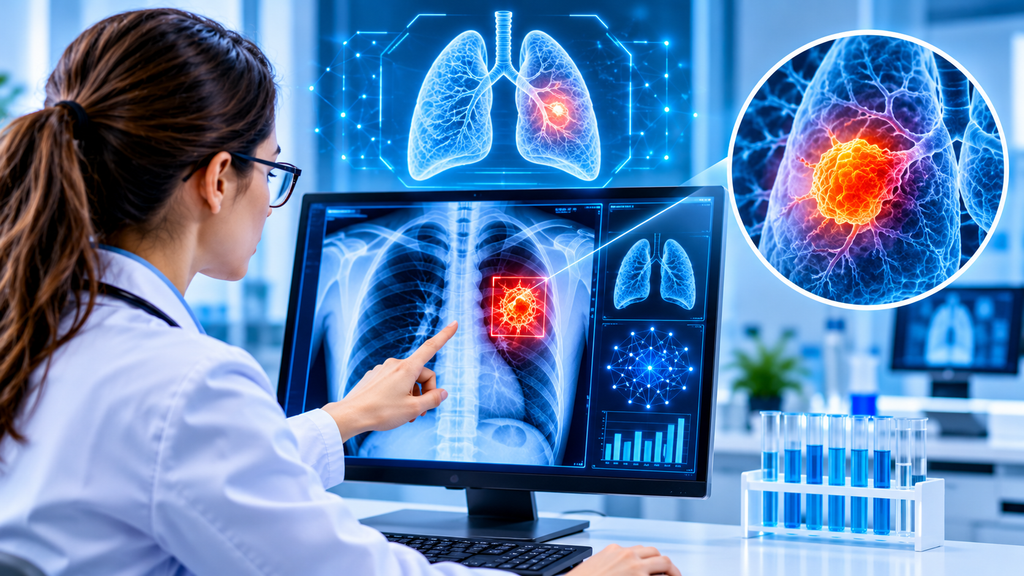
Artificial intelligence (AI) is changing the way researchers study cancer. AI tools can examine medical scans and find patterns that may be hard to notice during a normal review. These patterns may help doctors understand cancer risk and decide if more tests are needed. Researchers are studying AI for cancers such as pancreatic and lung cancer. Two examples are REDMOD and Sybil. Both use medical images, but they have different purposes. AI cannot confirm cancer on its own. It is a tool that may help doctors make better decisions. What Is AI in Cancer Detection? AI in cancer detection means using computer systems to study medical information and find patterns linked to cancer. These systems can examine: For example, an AI tool can study a CT scan and find unusual patterns. A doctor can review the result and decide whether the patient needs more tests. AI in Pancreatic Cancer Detection Pancreatic cancer can be hard to find in its early stages. Some people have no clear symptoms at first. Others may have symptoms that are also caused by common health problems. Pancreatic ductal adenocarcinoma (PDAC) is the most common type of pancreatic cancer. Researchers are studying whether AI can find signs linked to this disease in scans taken before diagnosis. Why Is Pancreatic Cancer Hard to Detect? The pancreas is deep inside the abdomen. Small changes may be difficult to see on a scan, especially before a clear tumor forms. Possible symptoms include: These symptoms do not always mean a person has cancer. A doctor must check the cause. How Does the REDMOD AI Model Work? REDMOD is an AI model developed by Mayo Clinic researchers. It studies abdominal CT scans to find patterns linked to pancreatic cancer. The model uses a method called radiomics. This method measures features in medical images, such as the shape and texture of tissue. REDMOD does not look only for a clear tumor. It also studies smaller image details that may be linked to the disease. Researchers hope this method can help identify signs that may not be easy to notice during a routine scan review. Can REDMOD Find Signs Before Diagnosis? A study published in Gut examined REDMOD using CT scans taken before patients were diagnosed with pancreatic cancer. The study reported that the model identified about 73% of the pre-diagnostic cases studied. The median time between the scan and diagnosis was around 16 months. These results are promising, but they need careful explanation. The 73% figure does not mean AI can detect 73% of all pancreatic cancer cases. It refers to the cases examined in the study. More research is needed to find out how well REDMOD works in everyday medical care. AI in Lung Cancer Detection Lung cancer is another area where researchers are testing AI. Finding lung cancer early can help doctors assess treatment options sooner. Low-dose computed tomography (LDCT) is used to screen people who meet certain risk criteria. Researchers are also studying whether AI can use these scans to estimate future lung cancer risk. What Is Sybil AI? Sybil is a deep-learning model developed through research involving MIT and Mass General Brigham. It uses a single low-dose chest CT scan to estimate a person’s future risk of lung cancer. Sybil studies patterns in the scan. It then produces a risk estimate that may help doctors assess a patient. The model focuses on information found in the CT image. This is different from risk methods that mainly use details such as age and smoking history. Sybil is a research tool. It is not a test that confirms cancer. Can Sybil Predict Lung Cancer Six Years Ahead? Research has shown that Sybil can estimate lung cancer risk for up to six years after an initial CT scan. This does not mean that Sybil finds a tumor six years before it appears. It means the model estimates the chance of developing lung cancer during that future period. Its results can vary between patient groups. Doctors must consider other health information before making decisions. REDMOD vs. Sybil REDMOD and Sybil both use AI to study medical images. However, they focus on different cancers. FeatureREDMODSybilCancer typePancreaticLungScan usedAbdominal CTLow-dose chest CTMain purposeFind patterns before diagnosisEstimate future cancer riskResearch focusEarlier pancreatic cancer signsLung cancer risk over time The two models have different roles. Their results should not be treated as the same. Benefits of AI in Cancer Detection AI may offer several benefits in cancer research and medical care. 1. Finding Risk Patterns AI can study medical images and look for patterns linked to cancer. This may help doctors decide which patients need more checks. 2. Studying Scans in More Detail Medical scans contain many details. AI can examine these details in a systematic way and find patterns that may be difficult to notice. 3. Making Use of Existing Scans Some AI research uses scans that patients already had for other medical reasons. These scans may contain useful information for further study. 4. Supporting Doctors AI results may give doctors extra information when they decide whether a patient needs another scan, a specialist visit, or more tests. Limits of AI Cancer Detection AI has potential, but it also has limits. Researchers must test these tools carefully before they become part of routine care. False Results An AI tool may mark a scan as suspicious even when the patient does not have cancer. This is called a false positive. It may lead to extra tests, worry, or procedures that are not needed. Doctors must review AI results before taking action. Need for More Research A model may perform well in a research study but give different results in a hospital. More testing in real medical settings is needed. Data Quality AI models learn from the data used to develop them. Differences in scanners, scan methods, and patient groups can affect their results. Cost and Access Hospitals need suitable equipment, trained staff, secure systems, and proper medical checks to use AI tools. These needs may affect