Stress Hives: 7 Proven Ways to Stop Anxiety Welts Fast
The timing is what convinces most people. The welts show up the week of a court date, three days into a family crisis, the night before a presentation you have been dreading. You have not eaten anything unusual. You have not started any medication. Yet there they are — raised, itchy, spreading.
Then the loop tightens. The hives make you anxious. The anxiety makes the hives worse. You lie awake scratching at two in the morning, which wrecks your sleep, which raises your stress the following day, which brings a fresh outbreak by evening.
Stress hives are real. The connection is not imagined, and it is not a polite way of saying the problem is in your head. But the relationship works differently from how most people assume, and understanding that difference is what makes it treatable.
Quick Overview
| Question | Short answer |
|---|---|
| Can stress cause hives? | It rarely creates them from nothing, but it strongly lowers the threshold at which they appear |
| How fast do they show up? | Hours to a few days after a stressful period, sometimes during |
| What do they look like? | Identical to other hives — raised, itchy, blanching welts that move |
| Common locations | Chest, neck, face, arms, back |
| How long do they last? | Individual welts under 24 hours; episodes days to weeks |
| First-line treatment | Regular non-drowsy antihistamines, plus stress reduction |
| Do they need a doctor? | Yes if lasting over six weeks, or with any swelling or breathing difficulty |
What Is Actually Happening in Your Skin
To understand stress hives, you first need to know that your skin is not a passive covering. It is densely wired with nerve endings, and those nerve endings sit right alongside your mast cells — the immune cells that store histamine.
That physical proximity is the whole story.
When you are under stress, several things happen at once:
Nerve endings in the skin release neuropeptides. The most important is substance P, which binds directly to receptors on mast cells and triggers them to degranulate. No allergen required. Your nervous system is talking straight to your immune cells, and histamine floods into the skin.
Corticotropin-releasing hormone rises. This stress hormone, released during activation of the HPA axis, also activates mast cells directly. It is a second independent pathway to the same outcome.
Skin barrier function declines. Sustained stress measurably slows barrier repair, making skin more reactive to irritants it would normally shrug off.
Body temperature and sweating change. Acute anxiety raises core temperature and triggers sweating, which in people with cholinergic urticaria is itself a direct trigger.
Sleep collapses. Sleep deprivation increases inflammatory signalling and, separately, amplifies how intensely the brain perceives itch. The same welt feels considerably worse on four hours of sleep.
So the honest framing is this: stress does not usually invent hives in someone with no tendency towards them. What it does is lower the activation threshold so dramatically that triggers you would normally tolerate now produce a full outbreak. For a broader look at the underlying biology, see our main guide on hives on skin and how they form.
Common Symptoms of Stress Hives
Visually, stress hives are indistinguishable from any other kind. That is worth stating plainly, because there is no test that identifies stress as the cause — the diagnosis comes from the pattern, not the appearance.
What you will see:
- Raised welts, pink or red on lighter skin, often skin-toned or purplish on brown and Black skin
- Welts that blanch — press one and the centre pales, then refills
- Individual welts that fade within hours while new ones appear elsewhere
- Merging patches with irregular, wavy borders
- Intense itching, typically worst in the evening and overnight
Patterns that specifically suggest stress involvement:
- Outbreaks that track identifiable stressful events
- Clustering on the chest, neck, and face — areas people describe as flushing
- Worsening in the evening as the day’s tension catches up
- Improvement during holidays or after a stressful period resolves
- Accompanying symptoms of stress: tension headaches, jaw clenching, disturbed sleep, digestive upset
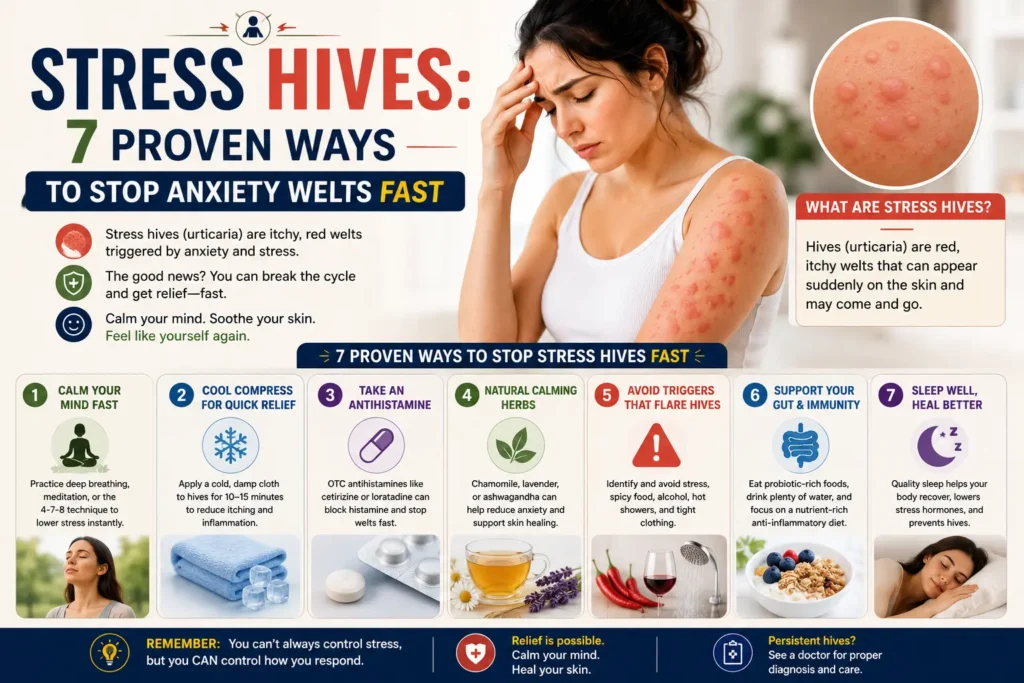
Stress hives versus other stress skin reactions
| Reaction | What it looks like | Key difference |
|---|---|---|
| Stress hives (urticaria) | Raised welts that move and blanch | Individual spots resolve within 24 hours |
| Stress-flared eczema | Dry, scaly, cracked patches | Stays in fixed locations; skin texture changes |
| Anxiety flushing | Diffuse redness, no raised edges | Flat, no distinct welts |
| Cholinergic urticaria | Tiny pinpoint welts with red flush | Triggered by the temperature rise, not the emotion |
| Stress-related psoriasis flare | Thick, silvery, scaly plaques | Chronic and fixed, does not migrate |
Is It Stress or Something Else?
Before settling on stress as your explanation, rule out the more concrete causes. Stress is a plausible diagnosis, which makes it an easy one to reach for prematurely.
Ask yourself:
- Did you start any new medication in the past few weeks? NSAIDs like ibuprofen are a frequent culprit and easily overlooked.
- Have you been unwell? Viral infections are the leading cause of sudden hives, and mild illness is easy to dismiss.
- Do the welts appear where clothing presses, or after cold or heat exposure? That points to a physical trigger.
- Does a specific food produce welts within two hours, repeatedly?
If any of those fit, stress may be a contributing factor rather than the driver. Our detailed breakdown of what causes hives and how to identify your trigger works through each possibility systematically.
There is also an important distinction between stress triggering an episode and stress unmasking an underlying chronic condition. Many people with chronic spontaneous urticaria — an autoimmune process where the body activates its own mast cells — have their first outbreak during a period of significant strain. The stress did not cause the autoimmunity; it revealed it. If your hives have continued beyond six weeks, this is the more likely picture, and our guide to chronic hives and long-term management covers what happens next.
Diagnosis
There is no blood test for stress hives. Diagnosis is clinical, and it rests on history: what you were experiencing when the welts began, how long individual welts last, what medications you take, and whether anything physical reproduces them.
Your doctor may stroke your forearm firmly to check for dermographism, or apply an ice cube to test for cold urticaria — both physical triggers that stress can amplify.
For acute stress-related hives, extensive testing is usually unnecessary. Broad allergy panels ordered without a matching history throw up incidental positives and send people down months of pointless dietary restriction.
If the hives have passed six weeks, guidelines support a limited workup: a full blood count, an inflammatory marker such as CRP, and thyroid antibodies. The thyroid check matters — autoimmune thyroid disease has the strongest and most consistent association with chronic urticaria.
Conventional Medical Treatment
Here is the point people most often get wrong: stress hives are still hives, and they respond to the same medication. Managing your stress is important, but it is not a substitute for treating the histamine reaction that is already happening.
Antihistamines, taken correctly
Second-generation antihistamines — cetirizine, loratadine, fexofenadine, levocetirizine — are first-line. Two practical points:
Take them daily throughout the stressful period, not just on bad days. Regular dosing prevents welts from forming. Reactive dosing means you are always chasing a reaction that has already started.
Standard doses are frequently insufficient. International urticaria guidelines endorse increasing the dose up to four times the standard amount in patients who do not respond — but only under medical supervision.
| Antihistamine | Onset | Sedation | Notes |
|---|---|---|---|
| Cetirizine | ~1 hour | Mild | Strong effect; some drowsiness |
| Fexofenadine | 1–2 hours | Minimal | Least sedating |
| Loratadine | 1–3 hours | Minimal | Slower onset, well tolerated |
| Levocetirizine | ~1 hour | Mild | Often taken in the evening |
A sedating antihistamine at night can be reasonable during a short flare when itching is destroying sleep, and the sedation is arguably useful in that specific context. Our guide on using Benadryl for hives safely covers appropriate short-term use and its limits.
If antihistamines are not enough
- Leukotriene receptor antagonists such as montelukast as an add-on
- Short courses of oral corticosteroids for severe flares — days, not weeks
- Omalizumab, an injected anti-IgE antibody with strong trial evidence in chronic urticaria resistant to antihistamines
- Ciclosporin for resistant cases under specialist supervision
Full detail on the treatment ladder is in our article on how to get rid of hives.
Treating the stress itself
This is where the evidence is thinner than the internet suggests, but not absent. Small studies of relaxation therapy, hypnosis, and cognitive behavioural approaches in chronic urticaria have shown improvements in symptom scores and quality of life. The mechanism is plausible and the interventions are low-risk.
What is worth pursuing:
- Cognitive behavioural therapy, particularly if anxiety about the hives has itself become a driver
- Consistent sleep timing — this may be the highest-yield single change
- Regular moderate exercise, provided heat does not trigger you
- Structured breathing practice for acute anxiety episodes
- If anxiety is severe enough to warrant it, treatment of the anxiety disorder in its own right
Herbal and Natural Remedies: What the Evidence Shows
These are supportive measures. They reduce discomfort and may lower overall reactivity. None is a cure, and none replaces medical treatment.
Vitamin D has the strongest evidence in this category. A randomised controlled trial published in Annals of Allergy, Asthma & Immunology found that adding high-dose vitamin D3 to standard antihistamine therapy produced significantly greater symptom improvement than antihistamines alone. Ask your doctor to check your level before supplementing at high doses — it is fat-soluble and accumulates.
Colloidal oatmeal baths reliably reduce itch, supported by evidence in inflammatory skin conditions generally. It will not stop welts forming, but the comfort is real and immediate. Very low risk.
Quercetin, a flavonoid in onions, apples, and capers, stabilises mast cells in laboratory studies. Human trials in urticaria remain small. Plausible, unproven. May interact with blood thinners.
Chamomile as a cooled compress has mild anti-inflammatory activity. Important caution: it is botanically related to ragweed, and people with that allergy can react badly.
Aloe vera gel provides cooling symptomatic relief on unbroken skin. Use pure gel without fragrance or alcohol, and patch-test first.
Ashwagandha and other adaptogens are widely promoted for stress. Evidence for reducing subjective stress and improving sleep in general populations is moderate; evidence specifically in urticaria is absent. Ashwagandha can affect thyroid function and is not appropriate in pregnancy or with thyroid medication without medical advice.
What to be sceptical of: any product promising to cure stress hives permanently, “detox” protocols, and undisclosed herbal blends. Some imported creams marketed for skin conditions have been found to contain unlabelled corticosteroids — which is why they appear to work dramatically and then rebound badly on stopping.
Home Care That Breaks the Cycle
- Cool compresses, not ice. Ten to fifteen minutes with a cool damp cloth interrupts itch signalling. Avoid ice unless cold urticaria has been ruled out.
- Lower the shower temperature. Hot water is one of the most common self-inflicted flare triggers, and stressed people gravitate towards long hot showers.
- Keep the bedroom cool, around 18°C, with light bedding. Night-time itch has a large temperature component.
- Trim your nails short. Scratching physically triggers new welts in anyone with a dermographic tendency, which is a self-sustaining loop.
- Substitute pressure for scratching. Firm pressure or a cool cloth interrupts the itch signal without traumatising the skin.
- Loose cotton clothing. Friction under tight synthetic fabric drives welts, especially at waistbands and straps.
- Protect your sleep window deliberately. Consistent bedtime, no screens for the last half hour, evening antihistamine dose. Sleep is where the loop most easily breaks.
- Photograph outbreaks. They vanish before appointments with remarkable reliability.
Foods to Eat and Foods to Avoid
Unless you have a confirmed food allergy, diet is a secondary factor here — but a few adjustments genuinely help during a stress flare.
| Generally well tolerated | Worth reducing during a flare |
|---|---|
| Fresh meat, poultry, fresh fish | Aged cheese, cured and processed meats |
| Rice, oats, quinoa | Fermented foods, soy sauce, vinegar |
| Most fresh vegetables | Tomatoes, spinach, aubergine |
| Apples, pears, blueberries | Strawberries, citrus, pineapple |
| Oily fish for omega-3s | Alcohol, especially red wine |
| Water, caffeine-free herbal teas | Excess caffeine, energy drinks |
Two specific mentions. Alcohol dilates blood vessels, raises skin temperature, and wrecks sleep quality — and it is exactly what stressed people reach for. It is one of the most consistently self-reported flare triggers. Caffeine does not directly cause hives but amplifies anxiety and delays sleep onset, feeding the cycle from the other end.
7 Proven Ways to Stop Stress Hives
These are the seven steps that make the most difference in practice — combining what stops the histamine reaction with what lowers your overall stress load.
- Keep a combined stress and symptom diary for a month. Rate stress 1–10 daily alongside outbreaks. The correlation either shows up clearly or it does not, and either answer is useful.
- Start antihistamines preventively ahead of a known stressful period — exams, a court date, a move — rather than waiting for welts.
- Protect sleep as a medical intervention, not a luxury. This is often the single highest-yield change.
- Avoid NSAIDs if they aggravate you; paracetamol is usually the safer analgesic, but confirm with your doctor.
- Keep skincare simple — fragrance-free, minimal ingredients, no exfoliating acids during flares.
- Address the anxiety-about-hives loop directly. For many people the fear of the next outbreak becomes a bigger driver than the original stressor.
- Build in genuine recovery time. The NHS guidance on stress management offers practical starting points if you are not sure where to begin.
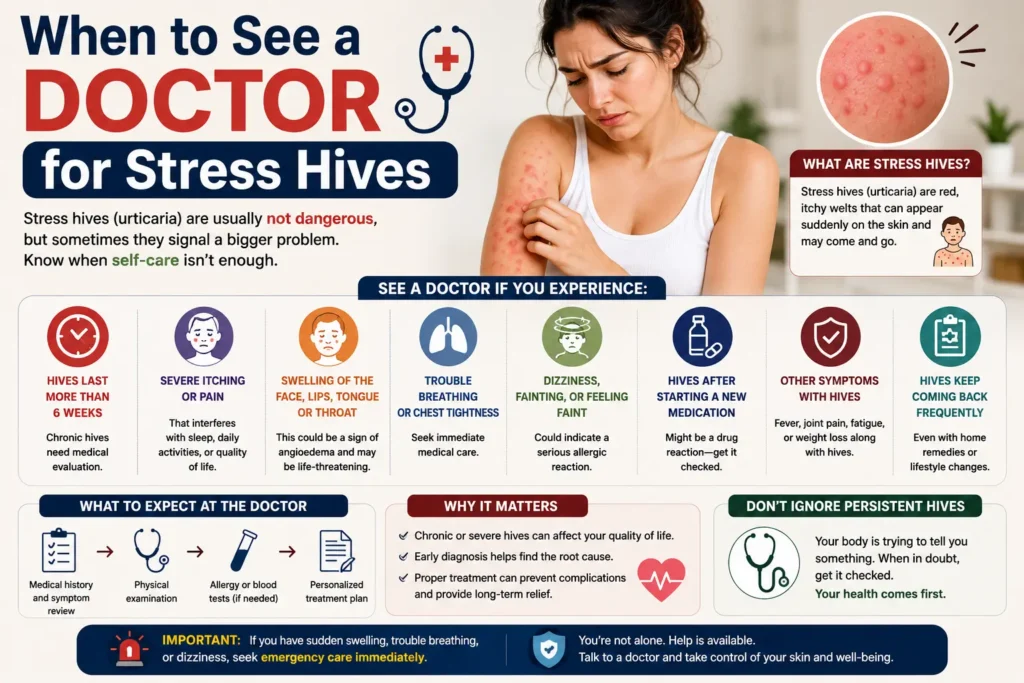
When to See a Doctor
Book an appointment if:
- Hives have continued beyond six weeks
- Itching is disrupting sleep or daily functioning
- Individual welts last more than 24 hours, hurt, or leave bruising
- Over-the-counter antihistamines are not controlling symptoms
- You have recurrent swelling of the lips or eyelids
- Anxiety or low mood is significant in its own right
- Hives are accompanied by fever, joint pain, or weight loss
Seek emergency care immediately for difficulty breathing, throat tightness, swelling of the tongue or mouth, hoarseness, dizziness, fainting, or hives spreading rapidly with vomiting. Use an epinephrine auto-injector first if prescribed, then call emergency services. Panic attacks and anaphylaxis can feel superficially similar — if you are unsure, treat it as the emergency.
Final Thoughts
The most useful reframe for stress hives is this: you are dealing with two problems that feed each other, and you need to interrupt both. Treating only the stress leaves you itching while you meditate. Treating only the histamine leaves the underlying pressure intact, so the flares keep returning.
The medication side is straightforward and often under-used — a regular daily second-generation antihistamine, at an adequate dose, taken throughout the stressful period rather than reactively. Many people struggle for months on an occasional half-dose and conclude that antihistamines do not work for them.
The stress side is slower and less satisfying, but sleep is the lever worth pulling first. It is the point where the cycle is most easily broken, and it improves both the reaction itself and how badly you feel it.
And if the welts outlast the stressful period by weeks, take that seriously rather than assuming you are simply not relaxing hard enough. Persistent hives usually reflect a chronic process that stress unmasked rather than created — and that process has its own effective treatment pathway. The Mayo Clinic overview of chronic hives is a reliable starting point for understanding what that involves.
Medical disclaimer: This article is for general information and is not a substitute for professional medical advice, diagnosis, or treatment. Always consult a qualified healthcare provider about your individual circumstances, particularly before starting any supplement or stopping any prescribed medication.
Frequently Asked Questions
Can stress alone cause hives? Stress rarely creates hives in someone with no underlying tendency, but it lowers the threshold at which mast cells release histamine so significantly that ordinary triggers now produce a full outbreak. The connection is real and mediated through nerve signals acting directly on skin immune cells.
How long do stress hives last? Individual welts fade within 24 hours, usually within a few hours. An episode tied to a specific stressful period often settles within days to a couple of weeks once the pressure eases. Beyond six weeks, the diagnosis shifts to chronic urticaria.
What do stress hives look like? Exactly like any other hives — raised, itchy welts that blanch when pressed and move around the body. There is no visual feature unique to stress. The clue is the timing, not the appearance.
Where do stress hives usually appear? Most commonly the chest, neck, face, arms, and back, though they can appear anywhere. The upper body pattern overlaps with where people flush under emotional stress.
Do antihistamines work for stress hives? Yes. The welts are produced by histamine regardless of what triggered the release, so antihistamines are effective. Take them daily through the stressful period rather than only when welts appear.
Can anxiety medication help hives? Indirectly, if anxiety is a major driver. Treating an anxiety disorder appropriately often reduces flare frequency. Anxiety medication is not a treatment for urticaria itself and does not replace antihistamines.
Why are my hives worse at night? Cortisol naturally falls in the evening, body temperature rises under bedding, distractions disappear, and a morning antihistamine dose is wearing off. An evening dose of a long-acting antihistamine and a cooler bedroom usually help.
Can stress hives spread to someone else? No. Hives are an internal immune reaction and are not contagious under any circumstances.