Home Remedies for Constipation: 12 Natural Ways to Relief
Constipation is one of those health complaints people rarely talk about but almost everyone experiences at some point. The discomfort, the bloating, the straining, the feeling of never quite being finished — it is genuinely unpleasant, and it can quietly affect your mood and energy for days. The good news is that most constipation responds well to simple, natural measures you can start at home, and understanding what actually causes it makes those measures far more effective.
At its heart, constipation usually comes down to a few everyday factors: not enough fibre, not enough fluid, too little movement, and sometimes ignoring the urge to go. Address these, and the situation often improves on its own. There is no need to reach immediately for strong laxatives, which are best kept for when gentler approaches fall short — and the natural remedies below tackle the root of the problem rather than just forcing a short-term result.
This guide covers the most effective home remedies for constipation, how to use them well, and the signs that mean it is time to see a doctor rather than continue self-treating.
Quick Overview
| Remedy | How it helps |
|---|---|
| More fibre | Adds bulk and softens stool |
| More water | Keeps stool soft and moving |
| Regular exercise | Stimulates bowel movement |
| Prunes and dried fruit | Natural, gentle laxative effect |
| A regular toilet routine | Trains the bowel and avoids holding on |
| Warm drinks | Can stimulate the bowel |
| Reducing certain foods | Cutting back on low-fibre processed foods |
Why Constipation Happens
Constipation means passing stools less often than is normal for you, or having hard, dry stools that are difficult or uncomfortable to pass. What counts as “normal” varies a lot between people, so it is defined relative to your own usual pattern rather than a fixed number.
The most common causes are everyday and very fixable: a diet low in fibre, not drinking enough fluid, and too little physical activity. When there is not enough fibre and water, stool becomes hard and dry; when you move little, the bowel is less stimulated to push things along. Other contributors include ignoring the urge to go, changes in routine or travel, certain medications, stress, and some medical conditions. Because the common causes are so addressable, natural home remedies are genuinely effective for most constipation — targeting the underlying factors rather than just the symptom.

12 Home Remedies for Constipation
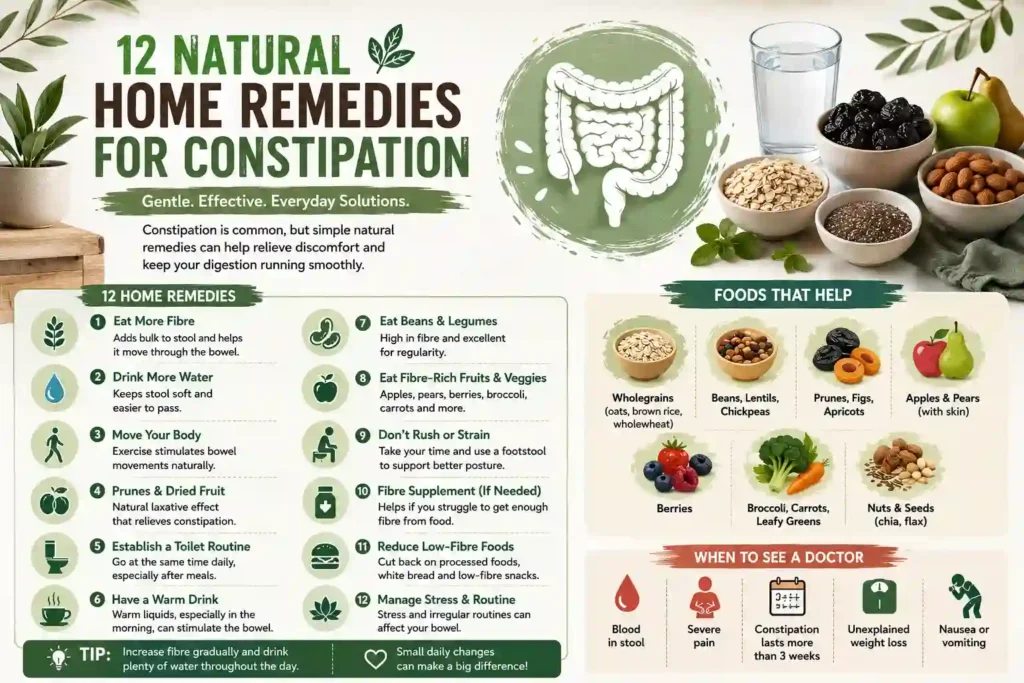
1. Eat more fibre. The single most effective long-term measure. Fibre adds bulk to stool and helps it move through the bowel. Good sources include wholegrains, fruits, vegetables, beans, lentils, nuts, and seeds. Increase fibre gradually to avoid bloating, and always with enough water.
2. Drink more water. Fibre works best with adequate fluid. Without enough water, extra fibre can actually make constipation worse, so the two go together. Staying well hydrated helps keep stool soft and easier to pass.
3. Move your body. Physical activity stimulates the natural muscle contractions that move stool through the bowel. Even a daily walk helps, and regular exercise is one of the most reliable ways to keep things regular.
4. Try prunes and dried fruit. Prunes are a well-known natural remedy for good reason — they contain fibre and a natural compound that has a gentle laxative effect. Other dried fruits like figs and apricots can help too.
5. Establish a regular toilet routine. The bowel responds to routine. Trying to go at the same time each day, often after a meal when the bowel is naturally more active, can help train it. Never ignore the urge to go, as holding on makes constipation worse.
6. Don’t rush or strain. Give yourself time and a relaxed setting. Straining is uncomfortable and can cause other problems. Raising your feet on a small stool while on the toilet, bringing your knees higher, can make passing stool easier for some people.
7. Have a warm drink. A warm drink, particularly in the morning, can stimulate the bowel for some people. Warm water or a caffeine-free warm drink is a gentle way to encourage movement.
8. Include beans and legumes. Lentils, chickpeas, and beans are excellent sources of fibre and are among the more effective foods for keeping the bowel regular.
9. Eat fibre-rich fruits and vegetables. Apples, pears, berries, broccoli, carrots, and leafy greens all add fibre and fluid. Pears and apples with their skin on are particularly helpful.
10. Consider a fibre supplement if needed. If you struggle to get enough fibre from food, a fibre supplement can help — taken with plenty of water. This is a gentler approach than stimulant laxatives.
11. Reduce low-fibre processed foods. Diets heavy in processed foods, white bread, and low-fibre snacks contribute to constipation. Shifting towards whole foods naturally increases fibre and improves regularity.
12. Manage stress and routine. Stress and disrupted routines, including travel, can affect the bowel. Keeping to regular meals, sleep, and movement, and managing stress, supports normal bowel function.
Foods That Help With Constipation
| Fibre-rich foods to include | Why they help |
|---|---|
| Wholegrains — oats, brown rice, wholewheat | Insoluble fibre adds bulk |
| Beans, lentils, chickpeas | High in fibre, keep things moving |
| Prunes, figs, apricots | Natural gentle laxative effect |
| Apples and pears (with skin) | Fibre and fluid |
| Berries | Fibre-rich and low in sugar |
| Broccoli, carrots, leafy greens | Fibre and nutrients |
| Nuts and seeds — chia, flax | Fibre and healthy fats |
A key point: increase fibre gradually and always with enough water. Adding a lot of fibre suddenly, or without enough fluid, can cause bloating and gas or even worsen constipation. A steady increase alongside good hydration is the way to get the benefit comfortably.
What About Laxatives?
Over-the-counter laxatives have their place for short-term relief when natural measures are not enough, but they are best used occasionally rather than relied upon. Different types work in different ways, and some are gentler than others. Because regular long-term use of certain laxatives without medical advice can cause problems, and because persistent constipation should be properly assessed, laxatives for ongoing constipation are best guided by a pharmacist or doctor. The natural remedies above address the root causes and are the better first approach for most people.
Our guides on related digestive topics, GERD symptoms and gastritis symptoms, cover other common causes of digestive discomfort.
Understanding Fibre: The Two Types
Fibre is the cornerstone of natural constipation relief, and understanding that there are two types helps you use it well, because they work in slightly different ways.
Insoluble fibre adds bulk to the stool and helps it move more quickly through the bowel, acting a little like a broom sweeping things along. It is found in wholegrains, wheat bran, nuts, seeds, and the skins of many fruits and vegetables. This is the type most directly associated with relieving constipation by keeping the bowel active and the stool bulky.
Soluble fibre dissolves in water to form a soft gel, which helps soften the stool and makes it easier to pass. It is found in oats, beans, lentils, apples, pears, and many vegetables. Both types are valuable, and a varied diet of whole foods naturally provides a mix of the two, which is exactly what a healthy bowel benefits from.
The practical message is not to obsess over which type you are eating, but to include a variety of fibre-rich whole foods — grains, beans, fruits, vegetables, nuts, and seeds — so you get both. And, crucially, to increase fibre gradually and drink plenty of water alongside it. Fibre without enough fluid can backfire, so the water is not optional. Done steadily, raising your fibre intake is the most effective long-term way to prevent constipation returning.
Preventing Constipation From Coming Back
Relieving a bout of constipation is one thing; keeping it from returning is where lasting comfort comes from, and it relies on the same principles made into habits.
Building fibre-rich whole foods into every meal — rather than adding fibre only when problems strike — keeps the bowel working well day to day. Drinking enough fluid consistently, staying physically active, and keeping to a regular routine of meals, sleep, and toilet timing all support steady bowel function. Responding to the urge to go rather than repeatedly holding on is important too, since ignoring it can gradually blunt the body’s natural signals and contribute to constipation over time.
Being aware of the things that tend to trigger constipation for you — travel, changes in routine, certain foods, stress, or dehydration — lets you take extra care during those periods, drinking more water and prioritising fibre and movement. For people whose constipation is linked to a medication, discussing it with a doctor may open up alternatives or supportive measures. The overall aim is to make the natural remedies in this article part of everyday life rather than an emergency response, so that regular, comfortable bowel movements simply become your normal.
Constipation in Children and Older Adults
Constipation affects people of all ages, but two groups deserve a special mention because their situations differ a little.
In children, constipation is very common and often linked to diet, not drinking enough, toilet-training struggles, or holding on because passing a hard stool once was painful — which creates a cycle of avoidance. Gentle measures like offering more fibre-rich foods and fluids, encouraging regular relaxed toilet time, and plenty of patience usually help. However, any medicine or laxative for a child should only be given on the advice of a doctor or pharmacist, and persistent constipation in a child is worth discussing with a professional, especially in babies and young children.
Older adults are more prone to constipation for several reasons, including reduced activity, lower fluid and fibre intake, and a higher likelihood of taking medications that affect the bowel. The same natural measures apply, but because constipation in older people can sometimes relate to other health issues or medications, and because dehydration is a particular risk, it is worth being attentive and seeking advice if simple measures do not help. For anyone, a sudden and lasting change in bowel habits, at any age, is a reason to see a doctor rather than assume it is ordinary constipation.
When to See a Doctor
See a doctor if:
- Constipation is severe, or lasts longer than expected despite home measures
- It is a new and persistent change from your normal bowel pattern
- You have constipation alternating with diarrhoea
- You are relying on laxatives regularly
- Constipation comes with significant abdominal pain or bloating
Seek prompt medical attention for these warning signs, which need proper assessment:
- Blood in your stool or bleeding from the back passage
- Unexplained weight loss
- Persistent, severe abdominal pain
- A noticeable, unexplained change in bowel habits lasting weeks
- Constipation with vomiting or an inability to pass gas
These can signal a problem that needs investigation. The NHS guidance on constipation explains when to seek help.
Final Thoughts
Constipation is common, uncomfortable, and — reassuringly — usually very responsive to simple, natural measures. The foundations are unglamorous but genuinely effective: more fibre from whole foods, more water to go with it, regular movement, a consistent toilet routine, and not ignoring the urge to go. Prunes and fibre-rich foods add a gentle natural boost, and together these address the everyday causes behind most constipation rather than just forcing a short-term result.
The sensible approach is to reach for these natural measures first, giving them a little time to work, and to keep laxatives for occasional use or professional guidance rather than as a routine crutch. What matters is not ignoring a persistent change in your bowel habits, because while most constipation is harmless and easily improved, certain warning signs — particularly bleeding, unexplained weight loss, or a lasting change in pattern — need a doctor’s assessment. For the everyday constipation most people experience, though, a few simple changes are usually all it takes to get things comfortably moving again.
Medical disclaimer: This article is for general educational information and is not a substitute for professional medical advice, diagnosis, or treatment. See a doctor for persistent constipation, a lasting change in bowel habits, or any bleeding, unexplained weight loss, or severe pain.
Frequently Asked Questions
What is the best home remedy for constipation? There is no single best remedy, but the most effective combination is increasing fibre from whole foods, drinking plenty of water, and being physically active. Prunes and a regular toilet routine add further help. Together these address the common causes of constipation naturally.
How can I relieve constipation quickly? Gentle natural measures like drinking water, having a warm drink, eating prunes or other fibre-rich foods, and going for a walk can encourage a bowel movement. Raising your feet on a small stool while on the toilet may also help. For fast relief when these fall short, a pharmacist can advise on suitable options.
What foods help with constipation? Fibre-rich foods are best: wholegrains, beans and lentils, prunes and dried fruit, apples and pears with their skin, berries, broccoli, leafy greens, and seeds like chia and flax. Increase fibre gradually and with plenty of water to avoid bloating.
Does drinking water help constipation? Yes. Adequate fluid keeps stool soft and easier to pass, and it is essential for fibre to work properly. Without enough water, extra fibre can even make constipation worse, so water and fibre go hand in hand.
How much fibre do I need for constipation? Most people benefit from more fibre than they currently eat, from a variety of whole foods. Rather than a precise figure, aim to include fibre-rich foods at each meal, increasing gradually and with enough water. A pharmacist or doctor can advise if a fibre supplement is needed.
When should I see a doctor about constipation? See a doctor if constipation is severe or persistent despite home measures, if it is a new lasting change in your bowel pattern, or if it comes with warning signs like blood in the stool, unexplained weight loss, or severe abdominal pain. These need proper assessment.
Are laxatives safe to use? Occasional laxative use for short-term relief is generally fine, but relying on certain laxatives long-term without medical advice can cause problems. Natural measures that address the root causes are the better first approach, and persistent constipation should be reviewed by a doctor.