Cure vs Treat: 5 Crucial Differences That Change Your Health
A doctor tells one patient their infection is “cured.” She tells another that their condition is “well treated” and “under control.” To most people those two phrases sound almost the same — good news, problem handled, move on. But they describe two completely different situations, and mistaking one for the other leads to some of the most common and costly misunderstandings in medicine.
The person who thinks they are cured when they are only treated stops taking their medication and relapses. The person who thinks their condition can never be cured lives with more fear than the facts warrant. And the person shopping for a product that promises to “cure” something medicine can only manage is a target for exactly the kind of claim that regulators spend their days chasing down.
The words cure and treat carry real weight. Understanding what separates them — and where a third word, heal, fits in — genuinely changes how you make decisions about your own care.
Quick Overview
| Term | What it means | Example |
|---|---|---|
| Cure | The disease is eliminated; it is gone and does not require ongoing management | Bacterial infection cleared by antibiotics |
| Treat | The condition is managed to reduce symptoms, slow progression, or control it — but it remains present | Type 2 diabetes managed with medication and lifestyle |
| Heal | The body’s own repair process restores damaged tissue or function | A wound closing, a fracture knitting back together |
| Manage | Ongoing control of a long-term condition to keep it stable | Asthma kept in check with inhalers |
| Comfort / palliate | Relieving symptoms and suffering without altering the disease | Pain relief in advanced illness |
What Does “Cure” Actually Mean?
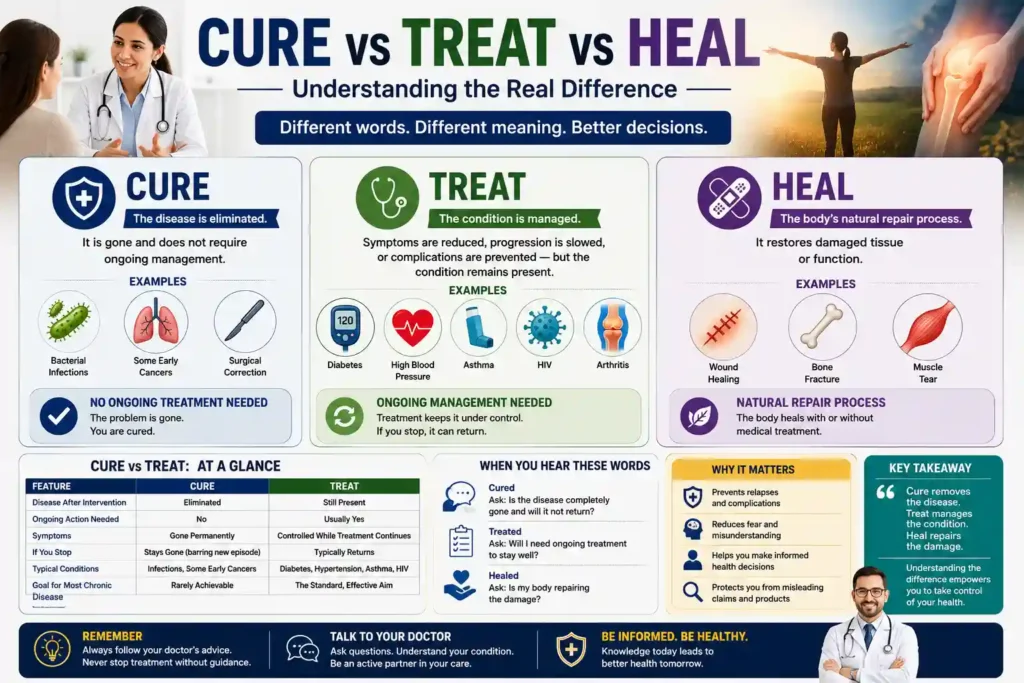
A cure means a disease has been eliminated. The underlying cause is gone, the condition is not expected to return on its own, and you do not need continuing treatment to keep it away.
The clearest examples are infections caused by bacteria. Strep throat, a urinary tract infection, or bacterial pneumonia can usually be cured with a course of antibiotics — the bacteria are killed, the infection resolves, and once you have recovered you are no longer carrying the disease. Certain cancers caught early and removed completely are described as cured after enough disease-free years pass. A surgeon repairing a specific structural problem can, in the right case, offer a genuine cure.
But cure is a stronger word than it first appears, and doctors use it carefully. Even after a genuine cure, some conditions can occur again as a new episode — being cured of one urinary tract infection does not protect you from catching another. That is not the disease coming back; it is a fresh one. The distinction matters because “cured” refers to this instance of this disease being eliminated, not lifelong immunity.
What Does “Treat” Actually Mean?
To treat a condition is to manage it — to reduce its symptoms, slow its progression, prevent complications, or keep it stable — while the underlying condition remains present in the body.
This is where the majority of modern medicine actually operates, and it is worth sitting with that fact. Most of the common conditions people live with today are treated rather than cured:
- Type 2 diabetes is controlled with medication, diet, and activity, but the underlying tendency remains
- High blood pressure is lowered with daily medication that must continue
- Asthma is managed with inhalers that keep airways open
- HIV is treated so effectively that people live long, healthy lives with an undetectable viral load — but the virus is not eliminated
- Rheumatoid arthritis is controlled to prevent joint damage
None of these is a failure of medicine. Treatment that turns a life-threatening or disabling condition into a manageable background presence is one of the great achievements of modern healthcare. But it depends on something a cure does not: continuation. Stop treating a treated condition and it typically returns, sometimes worse than before.
This single point explains an enormous amount of avoidable harm. People feel well because their treatment is working, conclude they no longer need it, stop, and relapse. The feeling of wellness was produced by the treatment — removing it removes the wellness.
Cure vs Treat: A Direct Comparison
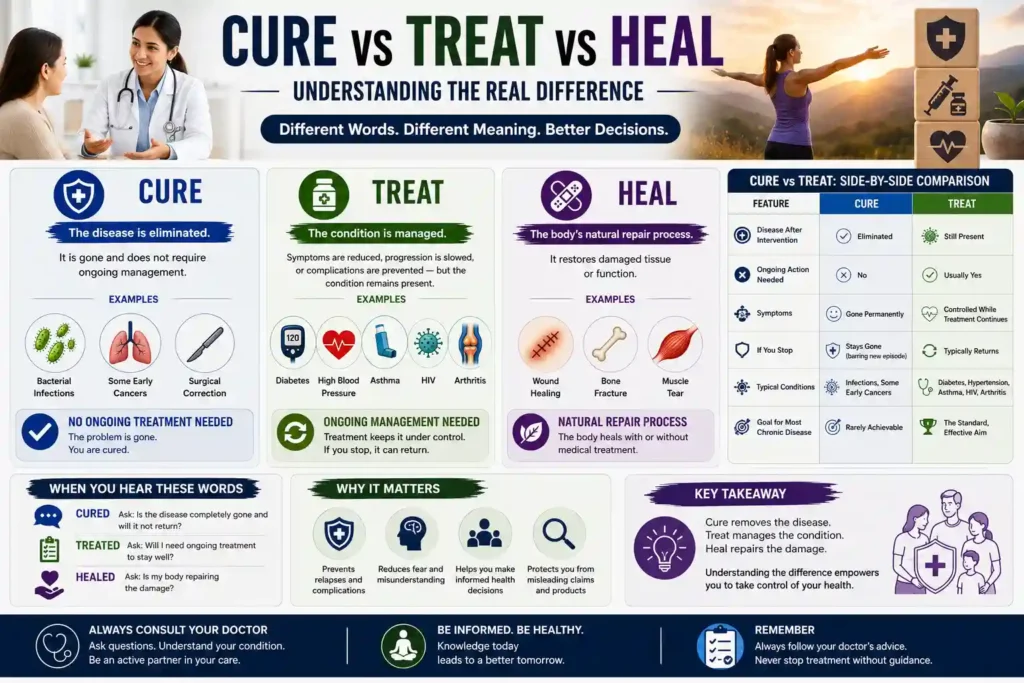
| Feature | Cure | Treatment |
|---|---|---|
| Disease after intervention | Eliminated | Still present |
| Ongoing action needed | No | Usually yes, often lifelong |
| Symptoms | Gone permanently | Controlled while treatment continues |
| If you stop | Stays gone (barring a new episode) | Typically returns |
| Typical conditions | Many bacterial infections, some early cancers | Diabetes, hypertension, asthma, HIV, arthritis |
| Realistic goal for most chronic disease | Rarely achievable | The standard, effective aim |
The most useful takeaway from this table is the last row. For most long-term conditions, treatment is the realistic and appropriate goal — and that is genuinely good news, not a consolation prize. A well-treated chronic condition can allow a full, normal life.
5 Crucial Differences Between Curing and Treating
If you remember nothing else, remember these five. They are the differences that actually change decisions.
1. The disease itself. A cure eliminates the underlying disease entirely. Treatment leaves the disease present in the body and works around it, keeping it controlled. This is the root difference from which the others follow.
2. Whether you can stop. After a genuine cure, you stop — the job is done. With treatment, stopping usually brings the condition back, often because the wellness you feel was produced by the treatment itself, not by the disease disappearing.
3. How long it lasts. A cure is typically a finite event: a course of antibiotics, a surgery, a defined endpoint. Treatment is frequently ongoing, sometimes for life, because it is managing rather than removing.
4. What “success” looks like. Success in a curable condition means the disease is gone. Success in a treatable condition means it is well controlled and stable — a different but equally real victory that too many people mistake for failure.
5. What it means for your choices. The cure-versus-treat distinction determines whether you can safely walk away from medication, how you judge a product’s claims, and whether “there’s no cure” should frighten you or simply redirect you toward excellent control. It is the most practically useful piece of information in this entire article.
Where “Heal” Fits In
Heal is the third word people blur together, and it means something distinct again. Healing is the body’s own biological repair process. A cut closes because skin cells divide and rebuild. A broken bone knits because the body lays down new bone. A torn muscle mends because tissue regenerates.
Treatment often supports healing — a cast holds a bone still so it can heal, stitches hold a wound edge together so it can close — but the actual repair is done by the body. You can be cured without much healing (an antibiotic kills bacteria while your tissue was never damaged), and you can heal without being cured (a diabetic foot ulcer can heal while the diabetes continues).
So the three words describe three different things: cure removes the disease, treat manages it, and heal repairs the damage. A single episode of illness can involve all three, or only one.
Diseases That Can Be Treated but Not Cured
This category causes a lot of anxiety, so it is worth being clear and calm about it. Many serious conditions currently have no cure but excellent treatment — meaning people live well with them for decades.
| Condition | Cure available? | What treatment achieves |
|---|---|---|
| Type 1 and type 2 diabetes | No | Near-normal blood sugar and prevention of complications |
| HIV | No | Undetectable virus, normal life expectancy |
| Asthma | No | Symptom-free daily life for most |
| High blood pressure | No | Blood pressure kept in a safe range |
| Rheumatoid arthritis | No | Disease slowed or halted, joints protected |
| Most viral infections (herpes, hepatitis B) | Varies | Suppression and control |
| Many autoimmune conditions | No | Remission and stability |
“Treatable but not curable” is not the same as “hopeless.” In several of these conditions, effective treatment produces outcomes that would have been unimaginable a generation ago. The framing that matters is control, not cure — and control is very often achievable.
There is also an important sub-question people search for constantly: which infections can be cured and which can only be treated?
- Bacterial infections — including bacterial sexually transmitted infections such as chlamydia, gonorrhoea, and syphilis — can generally be cured with the right antibiotics, because the antibiotic eliminates the bacteria.
- Viral infections are more variable. Some, like hepatitis C, can now genuinely be cured with modern antiviral drugs. Others, like HIV and herpes, can be treated and controlled extremely well but not eliminated with current medicine.
That difference — bacteria killed, versus a virus suppressed — is the single most useful rule of thumb for understanding why some conditions are cured and others managed.
“Cure Sometimes, Treat Often, Comfort Always”
There is an old medical aphorism worth knowing: cure sometimes, relieve often, comfort always — often quoted as “cure sometimes, treat often, comfort always.” It captures the honest hierarchy of what medicine can offer.
A cure is not always possible. Effective treatment usually is. And where neither cure nor further treatment can help — in advanced or terminal illness — the goal shifts to comfort: relieving pain, easing symptoms, and supporting quality of life. This is palliative care, and it is not giving up. It is a legitimate and skilled form of medicine focused on suffering rather than on the disease itself.
Understanding this spectrum — cure, treat, comfort — helps set realistic expectations at every stage of a health journey, and removes the false idea that anything short of a cure is a failure.
Why This Distinction Matters for Consumer Health Claims
Here is where the words move from academic to practical, and where you protect yourself and your money.
Regulators in most countries draw a hard legal line around the word cure. In the United States, for example, only approved drugs may claim to diagnose, treat, cure, or prevent a disease. Dietary supplements, by law, cannot make those claims — which is why supplement bottles carry a version of the disclaimer: “This product is not intended to diagnose, treat, cure, or prevent any disease.”
That disclaimer is not corporate throat-clearing. It is a legal boundary, and it tells you something important: a product carrying it has not been proven to cure or treat any specific disease, and is not permitted to say it does.
So when you see a supplement, device, or “natural remedy” promising to cure a named condition — especially a serious one — treat it as a red flag rather than a selling point. Genuine cures go through clinical trials and regulatory approval. A product simultaneously claiming to cure a disease and carrying the “not intended to cure” disclaimer is contradicting itself, and the disclaimer is the part that is legally true.
A few practical warning signs of an overreaching claim:
- The word “cure” attached to a chronic condition medicine can only manage
- Promises of instant or guaranteed results
- “Miracle” or “breakthrough” language without published trials
- A single product claimed to cure many unrelated conditions
- Testimonials standing in for evidence
Our approach across CureTreat is to distinguish clearly between what is scientifically supported and what is traditional or supportive — a principle you will see applied in our detailed guides such as how to get rid of hives and natural remedies and what the evidence actually shows.
How to Talk to Your Doctor About Cure vs Treatment
Getting clear answers is easier when you ask precise questions. Instead of “will this fix it?”, try:
- “Is this condition something we can cure, or something we manage?”
- “If we manage it, will I need treatment long-term or indefinitely?”
- “What happens if I stop treatment once I feel better?”
- “What does success look like here — cured, controlled, or comfortable?”
- “Is the goal to remove the disease, slow it, or relieve symptoms?”
These questions replace vague hope with a realistic plan, and they surface the single most important practical point: whether you can ever safely stop. For cured conditions, often yes. For treated ones, usually not without a plan.
Common Misunderstandings Worth Clearing Up
“I feel fine, so I must be cured.” Feeling well is often a sign that treatment is working, not that the disease is gone. This is the most dangerous confusion of the two words, and the most common reason people relapse.
“Treatment failed because it didn’t cure me.” For most chronic conditions, cure was never the goal. Successful control is the intended outcome, and it is a real success.
“Natural means it can cure what drugs only treat.” Being natural says nothing about whether something can cure a disease. Many effective drugs are derived from plants; many plant products do nothing for serious disease. The evidence, not the origin, is what matters.
“Once treated, an STD can’t come back.” A bacterial STI that is cured with antibiotics is gone — but you can be re-infected through new exposure. Cure of one episode is not protection against the next.
“Remission means cured.” Remission means the disease is inactive or undetectable, which is excellent — but in many conditions it can return, so it is monitored rather than declared over.
When to See a Doctor
See a healthcare professional, rather than relying on self-management or a purchased remedy, when:
- You are unsure whether your condition can be cured or only managed
- You are considering stopping a long-term treatment because you feel better
- A product promises to cure a serious condition and you are tempted to rely on it
- Symptoms return after you believed a problem was resolved
- You have a chronic condition and want to understand your realistic long-term outlook
- You are offered an expensive “cure” outside mainstream medicine for a serious illness
Any symptom that is severe, rapidly worsening, or accompanied by warning signs such as difficulty breathing, chest pain, confusion, or high fever needs prompt medical assessment regardless of these distinctions.
Final Thoughts
Cure and treat are not interchangeable, and the gap between them shapes real decisions. A cure removes a disease and lets you move on. Treatment manages a condition that stays with you, and depends on continuing rather than stopping when you feel well. Healing is the separate, quieter work your own body does to repair damage. And when neither cure nor further treatment can help, comfort remains a genuine and skilled goal of care.
For most of the long-term conditions people actually live with, the honest and encouraging truth is that treatment — not cure — is the realistic aim, and a well-treated condition can allow a full and normal life. Reframing “there’s no cure” as “there’s excellent control” is not spin; it is often the more accurate description of where medicine stands.
The most valuable habit you can build from all of this is simple: when a doctor, a label, or an advertisement uses the word cure, pause and ask whether it truly means the disease is gone — or whether treat, manage, or relieve would be the more honest word. That single question protects your health decisions and your wallet in equal measure.
Medical disclaimer: This article is for general educational information and is not a substitute for professional medical advice, diagnosis, or treatment. Always consult a qualified healthcare provider about your individual condition and before starting or stopping any treatment.
Frequently Asked Questions
What is the difference between treating and curing a disease? Curing eliminates the disease so it is gone and needs no ongoing management. Treating manages the condition — reducing symptoms, slowing progression, or keeping it stable — while the underlying condition remains present and usually requires continued care.
Does “treat” mean the same as “cure”? No. Treatment controls a condition that is still present; a cure removes it entirely. Many conditions can be effectively treated but not cured, which is why the words are not interchangeable.
What is the difference between treated and cured? “Cured” means the disease has been eliminated and is not expected to return on its own. “Treated” means it is being managed and controlled, but is still there and typically needs ongoing action to stay controlled.
What is the difference between cure, treat, and heal? Cure removes the disease, treat manages it while it remains, and heal is the body’s own repair of damaged tissue. A single illness can involve one, two, or all three.
Which diseases can be treated but not cured? Many, including type 1 and type 2 diabetes, HIV, asthma, high blood pressure, rheumatoid arthritis, and various autoimmune conditions. In most of these, treatment achieves excellent control and a normal or near-normal life, even without a cure.
Which STDs can be treated but not cured? Bacterial sexually transmitted infections such as chlamydia, gonorrhoea, and syphilis can generally be cured with antibiotics. Viral ones such as HIV and herpes can be treated and controlled very effectively but not cured with current medicine.
Why do supplements say “not intended to diagnose, treat, cure, or prevent any disease”? Because in many countries only approved medicines may legally make disease claims. Dietary supplements are barred from claiming to cure or treat specific diseases, so the disclaimer signals that the product has not been proven to do so.
Does “cure sometimes, treat often, comfort always” mean giving up? No. It describes the honest range of what medicine offers: cure when possible, effective treatment far more often, and comfort-focused care when neither can help. Comfort care, or palliative care, is a legitimate and skilled form of medicine, not an abandonment of the patient.