Dizziness Causes: 10 Surprising Reasons You Feel Dizzy

Dizziness Causes: 10 Surprising Reasons You Feel Dizzy Dizziness is one of those symptoms that is surprisingly hard to describe, which is part of what makes it unsettling. For one person it means the room seems to spin; for another, a lightheaded, faint feeling; for someone else, an unsteadiness on their feet or a floating, off-balance sensation. All of these get called “dizziness,” and yet they can have quite different causes. That vagueness, combined with how disorienting the feeling itself is, makes dizziness a symptom people often find alarming — even though most causes are not serious. The reassuring reality is that the majority of dizziness comes from common, treatable causes: problems with the inner ear balance system, drops in blood pressure, dehydration, or simple lightheadedness on standing. Understanding what you are actually experiencing — whether it is a spinning sensation, a faint feeling, or unsteadiness — is the first step to identifying the cause and easing it. And knowing the warning signs of the rarer serious causes means you can act appropriately without worrying about every fleeting moment of feeling off-balance. This guide covers the common causes of dizziness, how to tell the main types apart, ways to ease it, and when dizziness warrants seeing a doctor. Quick Overview Question Short answer What is dizziness? A term covering spinning, faintness, or unsteadiness Main types Vertigo (spinning) and lightheadedness (faintness) Common causes Inner ear problems, low blood pressure, dehydration Usually serious? No — most dizziness has treatable causes Easing it Rest, hydration, moving slowly, addressing the cause When to worry Dizziness with neurological signs, chest pain, or fainting What Do We Mean by Dizziness? “Dizziness” is an umbrella term for several different sensations, and pinning down which one you experience genuinely helps identify the cause. Broadly, it falls into two main types. Vertigo is the sensation that you or your surroundings are spinning or moving when they are not. It usually points to a problem with the inner ear, which houses the body’s balance system, or less commonly the parts of the brain involved in balance. Lightheadedness is a faint, woozy feeling, as though you might pass out, often related to reduced blood flow to the brain — from a drop in blood pressure, dehydration, or standing up too quickly. Some people also describe a general unsteadiness or loss of balance. Being able to tell your doctor which of these you feel — spinning, faintness, or unsteadiness — is one of the most useful pieces of information for working out the cause, because each points in a different direction. Most causes across all these types are common and treatable, which is why dizziness, while disorienting, is usually not a sign of anything dangerous. 10 Common Causes of Dizziness 1. Inner ear balance problems (BPPV). A very common cause of vertigo is benign paroxysmal positional vertigo (BPPV), where brief spinning is triggered by certain head movements, like rolling over in bed. It results from tiny particles in the inner ear and is usually treatable. 2. Dehydration. Not drinking enough fluid reduces blood volume and can cause lightheadedness and dizziness, often eased by rehydrating. 3. Low blood pressure or standing up quickly. A drop in blood pressure, including the brief drop when standing up too fast (postural hypotension), commonly causes lightheadedness. This is a frequent and usually harmless cause. 4. Low blood sugar. Going too long without eating, or a drop in blood sugar, can cause dizziness alongside other symptoms, often relieved by eating. 5. Inner ear infections and inflammation. Infections or inflammation affecting the inner ear or its nerve can cause vertigo, sometimes with nausea, often following a viral illness. 6. Anxiety and panic. Anxiety and panic attacks can cause dizziness and lightheadedness, sometimes with rapid breathing, reflecting the strong link between emotional state and physical symptoms. 7. Medications. Many medications list dizziness as a side effect. If dizziness began after starting a new medication, mention it to your doctor rather than stopping on your own. 8. Migraine. Some people experience dizziness or vertigo as part of migraine, sometimes with or without the headache. 9. Anaemia. A low level of healthy red blood cells, as in iron-deficiency anaemia, can cause dizziness alongside fatigue and breathlessness. Our guide on iron deficiency covers this cause. 10. Other causes. Dizziness can accompany infections, heart rhythm problems, and other conditions, which is why persistent, severe, or unexplained dizziness, or dizziness with warning signs, should be assessed. Vertigo vs Lightheadedness: Why the Difference Matters Distinguishing these two main types is one of the most helpful things you can do, because they point towards different causes. Feature Vertigo Lightheadedness Sensation Spinning or moving Faint, woozy, about to pass out Common source Inner ear balance system Reduced blood flow to the brain Common triggers Head movements, position changes Standing up, dehydration, low blood sugar Often with Nausea, unsteadiness A feeling of nearly fainting If your dizziness is a spinning sensation, especially triggered by head movements, it points towards the inner ear balance system, and conditions like BPPV are common and treatable. If it is a faint, woozy feeling, particularly on standing, it points towards blood pressure, hydration, or blood sugar. Noticing which you experience, and what brings it on, gives your doctor valuable clues and helps direct the right approach. How to Ease Dizziness For common, non-serious dizziness, these measures often help: For BPPV specifically, there are simple repositioning techniques a doctor or physiotherapist can perform or teach that are often very effective. Because the right approach depends on the cause, persistent or troubling dizziness is worth having assessed so the most effective treatment can be used. Staying Safe When You Feel Dizzy Because dizziness affects your balance and can come on suddenly, a practical priority is avoiding falls and injuries while it lasts — a point especially important for older adults, in whom falls can have serious consequences. The moment you feel dizzy, the safest immediate response is to stop what you are doing and sit
Headache Causes: 12 Proven Reasons & How to Find Relief
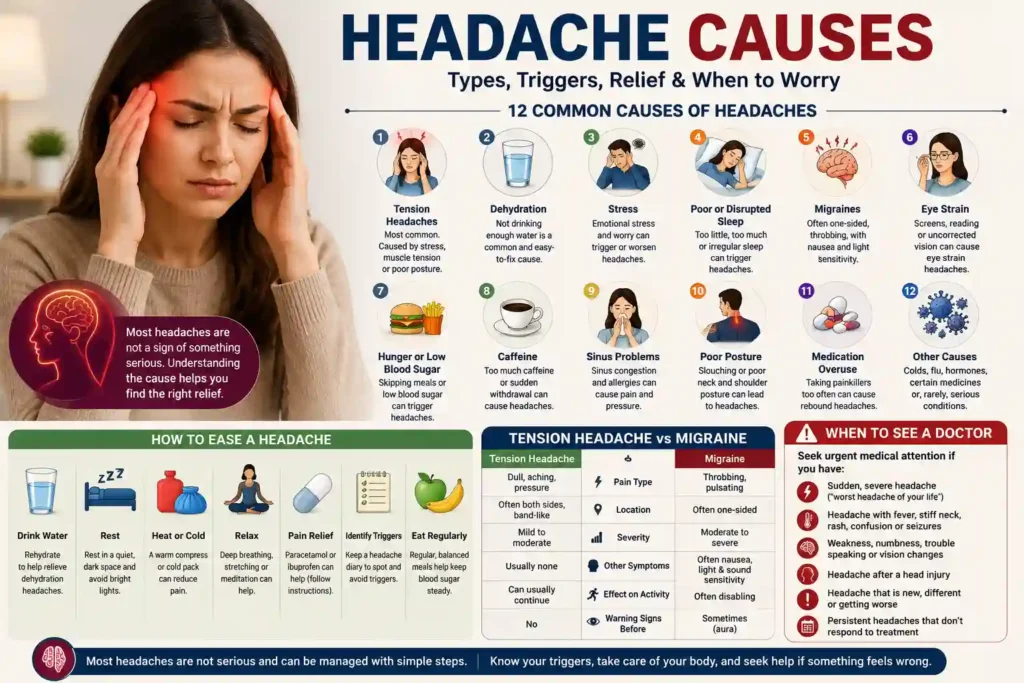
Headache Causes: 12 Proven Reasons & How to Find Relief Almost everyone gets headaches, and for most people they are an occasional, forgettable nuisance — a tight band of pressure after a long day, a dull ache that a glass of water and a rest sees off. But headaches are not all the same. They come in different types, with different causes, and understanding which kind you are dealing with makes a real difference to how you treat it and whether it is something to simply ride out or take more seriously. The reassuring reality is that the vast majority of headaches are what doctors call “primary” headaches — tension headaches and migraines chief among them — which, while genuinely unpleasant, are not caused by any dangerous underlying condition. Only a small minority of headaches signal something that needs urgent attention, and these usually come with recognisable warning signs. Knowing the common causes helps you find relief for the everyday kind and spot the rare situations that need a doctor. This guide covers the common causes of headaches, how to ease them, and the warning signs that mean it is time to seek help. Quick Overview Question Short answer Most common types Tension headaches and migraines Common triggers Stress, dehydration, poor sleep, eye strain, hunger Usually serious? No — most headaches are not dangerous Easing them Rest, hydration, pain relief, addressing triggers Migraine features Often one-sided, throbbing, with nausea or light sensitivity When to worry Sudden severe headache, headache with neurological signs Understanding Headaches A headache is pain or discomfort in the head or face, and it can range from a mild ache to severe, disabling pain. Doctors divide headaches into two broad groups. Primary headaches — including tension headaches, migraines, and cluster headaches — are headaches that are the problem in themselves, not a symptom of another condition. These make up the vast majority. Secondary headaches are caused by another underlying issue, ranging from something minor like a cold or dehydration to, rarely, something more serious. This distinction is reassuring, because it means most headaches, while painful, are not a sign of anything dangerous. Understanding the type and cause of your headache helps you treat it effectively — a tension headache, a migraine, and a dehydration headache each respond best to slightly different approaches. And knowing the warning signs of the rare serious headache means you can act appropriately without worrying unnecessarily about every ordinary ache. 12 Common Causes of Headaches 1. Tension headaches. The most common type. These cause a dull, aching pain, often described as a tight band around the head, usually on both sides. They are frequently linked to stress, muscle tension, poor posture, and tiredness. 2. Dehydration. Not drinking enough fluid is a common and easily overlooked cause of headaches. A dehydration headache often eases once you rehydrate. 3. Stress. Stress is one of the biggest triggers of both tension headaches and migraines, partly through muscle tension and partly through its wider effects on the body. 4. Poor or disrupted sleep. Too little sleep, too much sleep, or irregular sleep patterns can all trigger headaches. The link between sleep and headaches runs in both directions. 5. Migraines. Migraines are a distinct and often severe type of headache, typically throbbing and often one-sided, frequently with nausea, and sensitivity to light and sound. Some people experience warning signs beforehand. Migraines have their own triggers and management. 6. Eye strain. Prolonged screen use, reading, or uncorrected vision problems can strain the eyes and trigger headaches, often felt around the eyes and forehead. 7. Hunger or low blood sugar. Skipping meals or going too long without eating can bring on a headache in some people, often eased by eating. 8. Caffeine. Both caffeine itself and caffeine withdrawal can cause headaches. People who regularly consume caffeine may get a headache if they suddenly cut back. 9. Sinus problems. Congestion and inflammation in the sinuses, often with a cold or allergies, can cause pain and pressure in the face and forehead, sometimes called a sinus headache. 10. Poor posture. Sitting hunched or with poor neck and shoulder posture for long periods can cause muscle tension that leads to headaches. 11. Medication overuse. Ironically, taking pain-relief medication too frequently for headaches can itself cause ongoing headaches, known as medication-overuse or rebound headaches. This is a recognised trap worth knowing about. 12. Other causes. Headaches can accompany infections like colds and flu, certain medications, hormonal changes, and, rarely, more serious conditions — which is why certain warning signs always warrant attention. Tension Headache vs Migraine Two of the most common headache types are worth telling apart, because they feel different and are managed differently. Feature Tension headache Migraine Pain type Dull, aching, pressure Throbbing, pulsating Location Often both sides, band-like Often one-sided Severity Mild to moderate Moderate to severe Other symptoms Usually none Often nausea, light and sound sensitivity Effect on activity Can usually continue Often disabling Warning signs before No Sometimes (aura) Recognising which you tend to get helps you respond appropriately. Tension headaches often respond to rest, hydration, addressing stress and posture, and simple pain relief. Migraines are their own condition, often needing specific management, and people who get frequent or severe migraines benefit from seeing a doctor. Our guide on related everyday symptoms, such as fatigue causes, covers overlapping triggers like poor sleep and stress. How to Ease a Headache For a common tension or everyday headache, these measures often help: Most everyday headaches settle with these measures and a little time. Identifying and addressing your personal triggers is the most effective way to reduce how often they occur. The Main Types of Headache Explained Beyond tension headaches and migraines, it helps to understand the main headache types, since recognising yours guides how best to manage it. Tension headaches are the most common, producing a dull, pressing pain like a tight band around the head, usually on both sides. They are typically mild to moderate, and are strongly linked
Dry Mouth Causes: 10 Proven Reasons & How to Get Relief
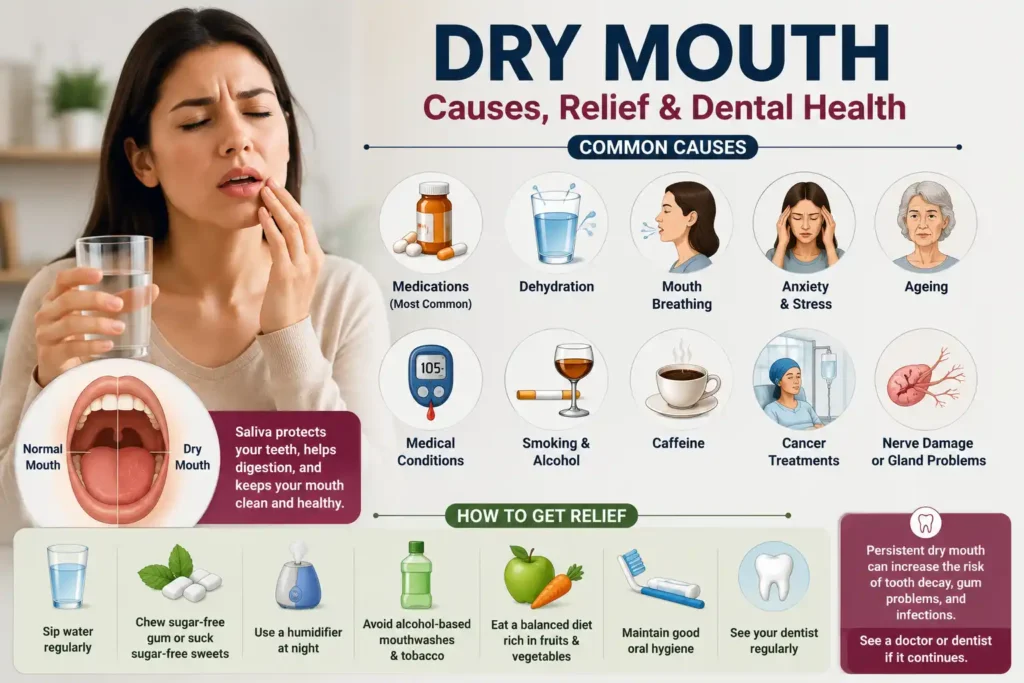
Dry Mouth Causes: 10 Proven Reasons & How to Get Relief A dry mouth is easy to dismiss as a minor annoyance — you feel parched, reach for water, and think little more of it. But when that dryness becomes persistent, it stops being trivial. A constantly dry mouth can make speaking, eating, and swallowing uncomfortable, disturb your sleep, affect your sense of taste, and — importantly — harm your dental health, because saliva does far more for your mouth than simply keeping it moist. Understanding why your mouth is dry is the first step to relieving it and protecting your teeth in the process. Saliva is quietly essential. It helps you chew and swallow, begins the process of digestion, keeps the mouth clean, and protects the teeth against decay. When saliva production drops, all of these functions suffer, which is why a persistently dry mouth is worth taking seriously rather than just tolerating. The reassuring news is that most dry mouth has identifiable, addressable causes — medications being the most common — and there are effective ways to find relief. This guide covers the common causes of dry mouth, how to get relief, why it matters for your teeth, and when dry mouth warrants seeing a doctor or dentist. Quick Overview Question Short answer What is it? Reduced saliva, leaving the mouth dry Medical name Xerostomia Most common cause Medications — a very frequent culprit Other causes Dehydration, mouth breathing, anxiety, certain conditions Why it matters Saliva protects teeth; dryness raises decay risk Relief Hydration, saliva stimulation, addressing the cause When to see someone Persistent dry mouth, or with other symptoms Why a Dry Mouth Matters Dry mouth, known medically as xerostomia, is the feeling of insufficient saliva in the mouth. While an occasional dry mouth — when nervous, dehydrated, or on waking — is normal, a persistently dry mouth is worth attention, because saliva plays several important roles that suffer when it runs short. Saliva moistens food so you can chew and swallow it, and it begins breaking down food as digestion starts. It washes away food particles and bacteria, helping keep the mouth clean and fresh. Crucially, it neutralises acids and helps protect the teeth against decay, which is why a dry mouth increases the risk of dental problems. It also supports your sense of taste and keeps the soft tissues of the mouth comfortable. When saliva is reduced, you may experience discomfort, difficulty eating and speaking, a changed sense of taste, and a higher risk of tooth decay and gum problems. This is why understanding and addressing the cause of dry mouth is about more than comfort — it protects your oral health too. 10 Common Causes of Dry Mouth 1. Medications. By far the most common cause. A very large number of medications list dry mouth as a side effect, spanning many different types. If your dry mouth began after starting a medication, this is the most likely explanation — but never stop a prescribed medication on your own; discuss it with your doctor. 2. Dehydration. Not drinking enough fluid, or losing fluids through illness, heat, or exercise, reduces saliva and dries the mouth. This is a common and easily corrected cause. 3. Mouth breathing. Breathing through the mouth, particularly during sleep, dries it out, which is why many people wake with a dry mouth. A blocked nose, snoring, or sleep apnoea can contribute. 4. Anxiety and stress. Feeling nervous or stressed commonly causes a dry mouth, reflecting the body’s response to stress. This is usually temporary, easing as the stress passes. 5. Ageing. While ageing itself does not necessarily cause dry mouth, it is more common in older adults, often related to the medications and conditions that become more frequent with age. 6. Certain medical conditions. Some conditions affect the salivary glands or the body’s fluid balance and can cause dry mouth. Diabetes, for instance, can be associated with dry mouth, as can certain autoimmune conditions that affect the glands. 7. Smoking and alcohol. Smoking and drinking alcohol can both contribute to a dry mouth, and alcohol-based mouthwashes can add to the dryness rather than helping. 8. Caffeine. Caffeine can contribute to a dry mouth, particularly in larger amounts, partly through its mild diuretic effect. 9. Cancer treatments. Certain cancer treatments, particularly those affecting the head and neck area, can reduce saliva production and cause dry mouth, which is managed with the guidance of the care team. 10. Nerve damage or gland problems. Less commonly, damage to the nerves supplying the salivary glands, or problems with the glands themselves, can reduce saliva and cause persistent dry mouth. Why Medications Are the Usual Suspect Because medications are such a common cause of dry mouth, it is worth understanding this connection. A very wide range of medications can reduce saliva as a side effect, and dry mouth becomes even more likely in people taking several medications at once, which is more common in older adults. If you notice dry mouth after starting a new medication, or you take multiple medications and have persistent dryness, this is well worth mentioning to your doctor or pharmacist. In some cases, they may be able to adjust the timing, the dose, or the medication itself, or suggest ways to manage the dryness. What you should never do is stop a prescribed medication on your own because of dry mouth — the medication is there for a reason, and any change should be made with professional guidance. But raising the issue is genuinely worthwhile, because dry mouth is a manageable side effect, not something you simply have to endure. This is one of the clearest examples of why identifying the cause of dry mouth matters: if a medication is behind it, the solution lies in working with your prescriber rather than in remedies alone. How to Get Relief From Dry Mouth For dry mouth, these measures often help: If dry mouth is persistent, or you suspect a medication or condition
Lump in Throat Feeling: 8 Causes & Effective Relief Tips

Lump in Throat Feeling: 8 Causes & Effective Relief Tips It is one of the more unsettling sensations the body produces: the persistent feeling that something is stuck in your throat — a lump, a ball, a tightness — even though you can eat and drink perfectly well and there is nothing actually there. You keep swallowing to clear it, but it will not budge, and the more you focus on it, the more noticeable it becomes. This experience is common, has a name — globus sensation — and, reassuringly, is usually harmless. The distinction that matters most here is between a feeling of a lump and genuine difficulty swallowing. With globus, swallowing food and drink is normal; it is the sensation of a lump between meals, or the feeling of tightness, that persists. That difference is important, because true difficulty swallowing needs prompt assessment, whereas the globus sensation, while annoying, is most often benign. Understanding what causes globus helps take the worry out of it and points towards what actually eases it. This guide covers the common causes of the lump-in-throat feeling, how to ease it, and the signs that mean it is worth seeing a doctor. Quick Overview Question Short answer What is it? A feeling of a lump or tightness in the throat with nothing there Medical name Globus sensation (globus pharyngeus) Is it serious? Usually not — most globus is harmless Common causes Acid reflux, anxiety and stress, muscle tension, postnasal drip Key distinction A feeling of a lump vs actual difficulty swallowing When to worry True difficulty swallowing, pain, weight loss, a lasting lump What Is the Globus Sensation? The globus sensation is the persistent feeling of a lump, tightness, or something stuck in the throat when there is nothing physically there. It is a genuine sensation, not imagined, but it does not involve an actual obstruction — which is why people with globus can eat and drink normally despite the uncomfortable feeling. It is a common experience, affecting many people at some point. The important thing to understand is that globus is a sensation with several possible underlying causes, most of them benign, rather than a sign of something stuck. The feeling often comes and goes, may be more noticeable when swallowing saliva or when focusing on it, and frequently improves when eating or drinking — which is the opposite of what happens with a genuine obstruction. This pattern is reassuring and helps distinguish globus from more concerning throat symptoms. Because the sensation can be persistent and unsettling, though, understanding its causes and knowing it is usually harmless brings real relief in itself. 8 Common Causes of a Lump in the Throat Feeling 1. Acid reflux. One of the most common causes. Acid flowing back up from the stomach can irritate the throat and the muscles around it, producing a sensation of a lump or tightness, sometimes without obvious heartburn. Reflux-related globus is well recognised — see our guide on GERD symptoms. 2. Anxiety and stress. There is a strong link between emotional state and the globus sensation. Anxiety and stress can cause tension in the throat muscles and heighten awareness of throat sensations, and the phrase “a lump in the throat” when emotional reflects this genuine connection. Stress-related globus is very common. 3. Muscle tension. Tension in the muscles of the throat, sometimes related to stress, can create a feeling of tightness or a lump. The throat muscles are sensitive to tension, and this is a frequent contributor. 4. Postnasal drip. Mucus dripping down the back of the throat from the nose and sinuses can create a sensation of something in the throat, along with frequent throat-clearing. 5. Dry throat. A dry throat, whether from dehydration, mouth breathing, or certain medications, can contribute to the sensation of a lump or tightness. 6. Frequent throat-clearing or swallowing. Ironically, the habit of repeatedly clearing the throat or swallowing to try to shift the sensation can irritate the throat and perpetuate the feeling, creating a self-sustaining cycle. 7. Heightened awareness. Once you notice the sensation, focusing on it can make it more prominent. This heightened awareness is part of why globus can persist and feel worse the more attention it receives. 8. Other causes. Less commonly, the sensation relates to other throat conditions, which is why a persistent lump feeling, particularly with any warning signs, should be assessed to rule out other causes. Globus vs Difficulty Swallowing: The Key Difference This distinction is the single most important thing to understand about the lump-in-throat feeling, because it separates a usually harmless sensation from a symptom that needs prompt attention. Globus sensation is a feeling of a lump or tightness, typically between swallows or when swallowing saliva, while actual eating and drinking are normal. The sensation often eases when eating or drinking. This is usually benign. True difficulty swallowing (dysphagia) is when food or drink genuinely sticks, catches, or is hard to get down — a mechanical problem with swallowing itself. This is different and should always be assessed by a doctor, as covered in our guide on difficulty swallowing. If you can eat and drink normally but have a persistent feeling of a lump between meals, that points towards globus. If food or drink actually sticks or is hard to swallow, that is dysphagia and needs assessment. Being clear about which you are experiencing helps you and your doctor respond appropriately — and, in the case of globus, offers reassurance. How to Ease the Globus Sensation For globus without warning signs, these measures often help: Many people find that once reflux, stress, or throat-clearing is addressed, and once they understand the sensation is benign, the globus feeling gradually settles. The reassurance that nothing is actually stuck is, for many, a significant part of the relief. The Anxiety Connection: Why Stress Makes It Worse The link between the globus sensation and anxiety deserves a closer look, because for many people it is central to why the feeling
Bloating Causes: 11 Reasons & Proven Ways to Ease It
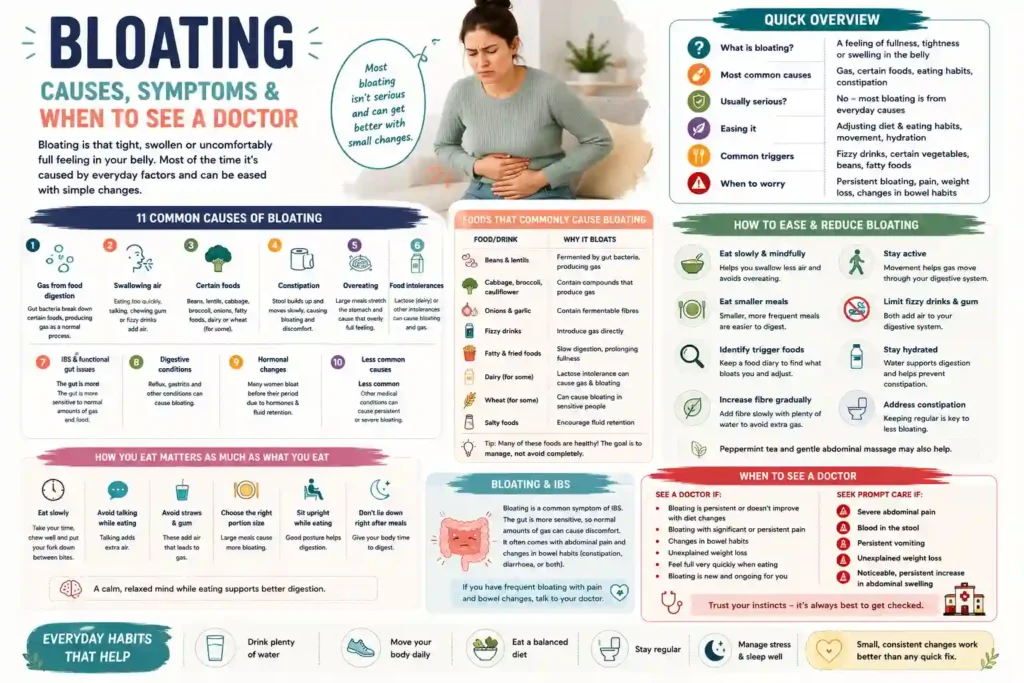
Bloating Causes: 11 Reasons & Proven Ways to Ease It That tight, swollen, uncomfortably full feeling in the belly — as though you have swallowed a balloon — is one of the most common digestive complaints there is. Bloating can turn a normal day uncomfortable, make clothes feel too tight, and leave you wondering what you did to deserve it. Most of the time, the answer is reassuringly ordinary: something about what or how you ate. But because bloating can have many causes, understanding what is behind yours is the key to easing it and knowing when it needs more attention. The encouraging news is that the vast majority of bloating is caused by everyday factors — the food you eat, how you eat it, and the normal workings of your digestive system — and responds well to simple changes. Occasional bloating after a big or gassy meal is completely normal. It is persistent, severe, or unexplained bloating that occasionally signals something needing a doctor’s attention, and knowing the difference lets you handle the common kind confidently while staying alert to the rest. This guide covers the common causes of bloating, how to ease it, the foods most likely to trigger it, and when bloating warrants seeing a doctor. Quick Overview Question Short answer What is bloating? A feeling of fullness, tightness, or swelling in the belly Most common causes Gas, certain foods, eating habits, constipation Usually serious? No — most bloating is from everyday causes Easing it Adjusting diet and eating habits, movement Common triggers Fizzy drinks, certain vegetables, beans, fatty foods When to worry Persistent bloating, pain, weight loss, changes in bowel habits Why We Feel Bloated Bloating is the sensation of increased pressure, fullness, or swelling in the abdomen, sometimes with a visibly larger belly. It most often results from a build-up of gas in the digestive system, or from the digestive process itself, though it can have other causes. Gas is produced normally as part of digestion, particularly when gut bacteria break down certain foods, and swallowed air adds to it. When gas builds up or moves slowly, or when the gut is sensitive to normal amounts, bloating results. Understanding that bloating is usually a normal part of digestion gone slightly awry helps take the worry out of it. Most bloating comes down to what you eat, how you eat, and how your particular digestive system handles things. Because these are everyday and largely addressable factors, simple changes ease most bloating. Knowing the causes, though, also helps you recognise the less common situations that need more attention. 11 Common Causes of Bloating 1. Gas from food digestion. The most common cause. When gut bacteria break down certain foods, particularly high-fibre foods, beans, and some vegetables, they produce gas, which can cause bloating. This is a normal process, though some people are more sensitive to it. 2. Swallowing air. Eating too quickly, talking while eating, chewing gum, and drinking fizzy drinks all introduce extra air into the digestive system, contributing to bloating. 3. Certain foods. Beans, lentils, cabbage, broccoli, onions, and other gas-producing foods commonly cause bloating. So do fatty foods, which slow digestion, and for some people, dairy or wheat. 4. Constipation. When stool builds up and moves slowly through the bowel, it commonly causes bloating alongside the discomfort of constipation itself. Our guide on home remedies for constipation covers easing this. 5. Overeating. Simply eating a large meal fills the stomach and can cause a bloated, uncomfortably full feeling, particularly with rich or heavy foods. 6. Food intolerances. Intolerance to certain foods, such as lactose (in dairy) or others, can cause bloating when those foods are eaten, as the body struggles to digest them properly. 7. IBS and functional gut issues. Irritable bowel syndrome and other functional digestive conditions commonly cause bloating, often alongside abdominal pain and changes in bowel habits. The gut in these conditions can be more sensitive to normal amounts of gas. 8. Digestive conditions. Conditions like acid reflux and gastritis can cause bloating among their symptoms. Our guides on GERD symptoms and gastritis symptoms cover these. 9. Hormonal changes. Many women experience bloating related to their menstrual cycle, particularly in the days before a period, due to hormonal changes and fluid retention. 10. Fluid retention. Bloating can sometimes relate to the body holding onto fluid, which can be influenced by diet, hormones, and other factors. 11. Less common causes. Occasionally, persistent or severe bloating relates to other conditions, which is why bloating that is ongoing, unexplained, or comes with warning signs should be assessed. Foods That Commonly Cause Bloating Common bloating triggers Why they cause it Beans and lentils Fermented by gut bacteria, producing gas Cabbage, broccoli, cauliflower Contain compounds that produce gas Onions and garlic Contain fermentable fibres Fizzy drinks Introduce gas directly Fatty and fried foods Slow digestion, prolonging fullness Dairy (for some) Lactose intolerance causes bloating Wheat (for some) Can cause bloating in sensitive people Salty foods Encourage fluid retention An important point: many of the foods that cause bloating, like beans and vegetables, are genuinely healthy, so the goal is usually not to avoid them entirely but to manage how they affect you. Increasing fibre gradually, cooking gas-producing vegetables, and identifying your personal triggers through a food diary all help you keep these nutritious foods in your diet while reducing bloating. Triggers vary a lot between people, so your own experience is the best guide. How to Ease and Reduce Bloating For everyday bloating, these measures often help: Some people find peppermint tea or gentle abdominal movement soothing. If bloating consistently follows specific foods, moderating those foods is often the most effective single step. How You Eat Matters as Much as What You Eat People tend to focus entirely on which foods cause bloating, but the way you eat can matter just as much, and adjusting your habits is often the easiest win of all. Eating quickly is one of the biggest culprits. When you rush
Sore Throat Causes: 10 Reasons & Effective Relief Tips
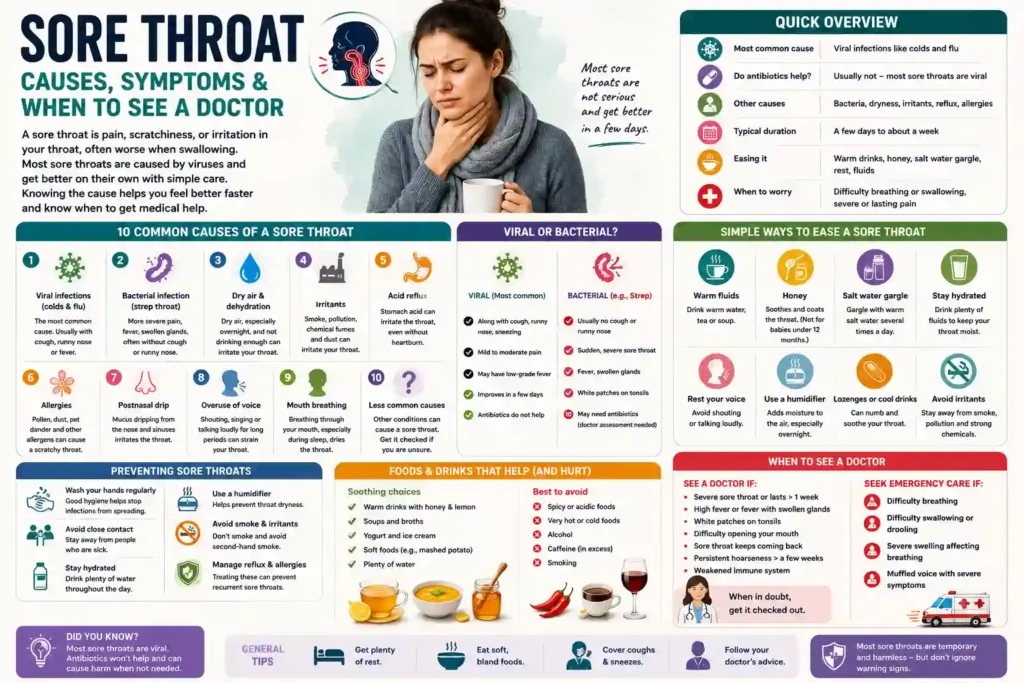
Sore Throat Causes: 10 Reasons & Effective Relief Tips A sore throat is one of the most familiar discomforts there is — that raw, scratchy, painful feeling that makes swallowing an ordeal and talking a chore. Most of the time it is the opening act of an ordinary cold, arriving with a runny nose and a cough and clearing within a few days. But a sore throat can have a range of causes beyond the common cold, and knowing which one you are dealing with helps you soothe it effectively and recognise the less common situations that need a doctor. The reassuring reality is that the vast majority of sore throats are caused by viral infections and get better on their own with simple home care. Antibiotics, which many people expect, usually do nothing for them, because they work only against bacteria. Understanding what is actually behind your sore throat, then, not only helps you ease it but also spares you unnecessary treatment — and helps you spot the minority of cases that need more attention. This guide covers the common causes of a sore throat, how to ease the discomfort at home, and when a sore throat warrants seeing a doctor. Quick Overview Question Short answer Most common cause Viral infections like colds and flu Do antibiotics help? Usually not — most sore throats are viral Other causes Bacterial infection, dryness, irritants, reflux, allergies Typical duration A few days to about a week Easing it Warm drinks, honey, salt water gargle, rest, fluids When to worry Difficulty breathing or swallowing, severe or lasting pain Why Your Throat Hurts A sore throat is pain, scratchiness, or irritation of the throat, often worse when swallowing. It happens when the tissues of the throat become inflamed or irritated — most commonly by an infection, but also by dryness, irritants, or other causes. The inflammation stimulates the nerve endings in the throat, producing that familiar raw, painful sensation. Understanding that a sore throat is a symptom rather than a single condition helps make sense of its many causes. The same painful throat can result from a virus, a bacterial infection, dry air, acid reflux, or overuse of the voice — each irritating or inflaming the throat in its own way. Most causes are harmless and temporary, which is why home care resolves the majority of sore throats, but knowing the possibilities helps you respond appropriately. 10 Common Causes of a Sore Throat 1. Viral infections (colds and flu). By far the most common cause. A sore throat is often the first sign of a cold or flu, usually alongside other symptoms like a runny nose, cough, or fever. These viral sore throats clear on their own within a few days. Our guide on home remedies for cold covers soothing this kind. 2. Bacterial infection (strep throat). A smaller proportion of sore throats are caused by bacteria, the best-known being strep throat. This can cause a more severe sore throat, often without the cough and runny nose of a cold, sometimes with fever and swollen glands, and may need medical assessment and antibiotics. 3. Dry air and dehydration. Breathing dry air, especially overnight or in heated rooms, can dry out and irritate the throat, causing soreness that is often worse in the morning. Not drinking enough can add to this. 4. Irritants. Smoke, including second-hand smoke, air pollution, chemical fumes, and dust can all irritate the throat and cause soreness, particularly with ongoing exposure. 5. Acid reflux. Acid flowing back up from the stomach can reach the throat and cause irritation and soreness, sometimes without obvious heartburn. A persistent sore throat, particularly with hoarseness or a morning sore throat, can relate to reflux — see our guide on GERD symptoms. 6. Allergies. Allergic reactions to pollen, dust, pet dander, and other allergens can cause a sore or scratchy throat, often through postnasal drip, where mucus drips down the back of the throat and irritates it. 7. Postnasal drip. Mucus dripping down the back of the throat from the nose and sinuses — whether from a cold, allergies, or sinus problems — irritates the throat and is a common cause of soreness and throat-clearing. 8. Overuse of the voice. Shouting, singing, or talking loudly for long periods can strain the throat and voice box, causing soreness and hoarseness. 9. Mouth breathing. Breathing through the mouth, particularly during sleep, dries the throat and can cause soreness on waking. 10. Less common causes. Occasionally a sore throat relates to other conditions, and a sore throat that is severe, persistent, or comes with certain warning signs needs assessment to identify the cause. Sore Throat: Viral or Bacterial? One of the most useful distinctions is whether a sore throat is likely viral or bacterial, because it affects whether antibiotics might help. A viral sore throat — the most common — typically comes with other cold or flu symptoms like a runny nose, cough, sneezing, and sometimes a mild fever. It clears on its own within a few days, and antibiotics do not help. A bacterial sore throat, such as strep, more often appears without a cough or runny nose, and may involve a more severe sore throat, fever, swollen tender glands in the neck, and white patches on the tonsils. This kind may benefit from assessment and, if confirmed bacterial, antibiotics. However, the two can be hard to tell apart with certainty, which is why a doctor may assess a severe or persistent sore throat rather than relying on guesswork. The key practical point is that most sore throats are viral and do not need antibiotics — a message that helps reduce unnecessary antibiotic use. How to Ease a Sore Throat at Home For a typical sore throat, these measures genuinely help: Over-the-counter pain relief can also ease the discomfort of a sore throat for adults, used as directed. Most sore throats settle within a few days with this kind of supportive care. Preventing Sore Throats While you
Nausea Causes: 12 Reasons & Proven Ways to Ease It
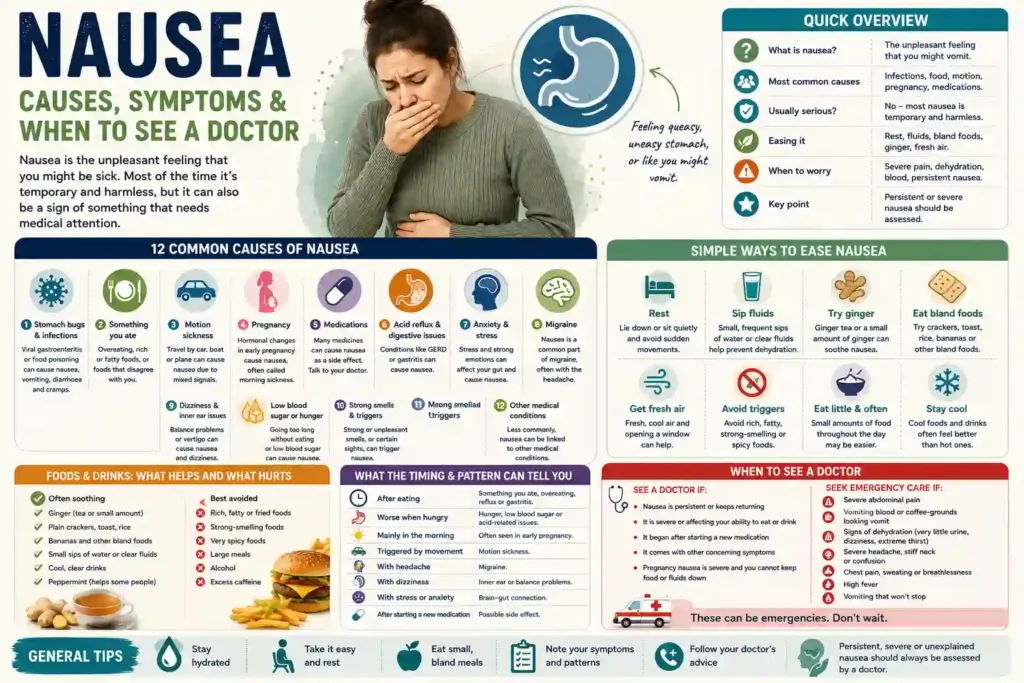
Nausea Causes: 12 Reasons & Proven Ways to Ease It Nausea is that deeply unpleasant, hard-to-describe feeling that you might be sick — the queasiness, the uneasy stomach, the sense that something is not right. It is one of the most common symptoms there is, and one of the least specific, because so many different things can bring it on. A single bout after a rich meal is easily explained; but when nausea keeps returning or lingers without an obvious reason, working out what is behind it becomes worthwhile. The reassuring reality is that most nausea is caused by something temporary and harmless — a passing bug, something you ate, motion, or a short-lived upset — and it settles on its own with a little care. But because nausea can also accompany a wide range of conditions, understanding the common causes helps you make sense of what you are feeling, ease it effectively, and recognise the less common situations that warrant a doctor’s attention. This guide covers the common causes of nausea, simple ways to ease it at home, and the warning signs that mean it is time to seek help. Quick Overview Question Short answer What is nausea? The unpleasant feeling that you might vomit Most common causes Infections, food, motion, pregnancy, medications Usually serious? No — most nausea is temporary and harmless Easing it Rest, fluids, bland foods, ginger, fresh air When to worry Severe pain, dehydration, blood, persistent nausea Key point Persistent or severe nausea should be assessed Why We Feel Nauseous Nausea is the body’s warning sensation that vomiting might follow, though it often occurs without any vomiting at all. It is controlled by parts of the brain that receive signals from many sources — the digestive system, the balance system in the inner ear, the bloodstream, and even emotional and psychological states. This is precisely why so many different things can trigger it: anything that stimulates these pathways can produce the feeling of nausea. This broad wiring explains why nausea accompanies such a wide range of situations, from a stomach bug to motion sickness to anxiety. It also means nausea is a symptom rather than a diagnosis — it points to something going on rather than being a condition in itself. Most of the time that “something” is minor and temporary, but identifying the likely cause helps you respond appropriately and know when it needs more attention. 12 Common Causes of Nausea 1. Stomach bugs and infections. Viral gastroenteritis — a stomach bug — is one of the most common causes, often with vomiting, diarrhoea, and cramps. Food poisoning from contaminated food acts similarly. These usually settle within a day or two. 2. Something you ate. Overeating, very rich or fatty foods, or foods that disagree with you can all cause nausea. This kind is usually short-lived and settles as digestion catches up. 3. Motion sickness. Travel by car, boat, or plane can cause nausea when the balance system in the inner ear and the eyes send conflicting signals to the brain. 4. Pregnancy. Nausea, often called morning sickness though it can occur any time of day, is very common in early pregnancy due to hormonal changes. It usually eases as pregnancy progresses. 5. Medications. Many medications list nausea as a side effect, and some treatments are particularly associated with it. If nausea began after starting a new medication, mention it to your doctor rather than stopping on your own. 6. Acid reflux and digestive conditions. Conditions like acid reflux and gastritis can cause nausea alongside their other symptoms. Our guides on GERD symptoms and gastritis symptoms cover these. 7. Anxiety and stress. The strong link between the brain and gut means anxiety, stress, and strong emotions can genuinely cause nausea, sometimes with a churning or knotted stomach. 8. Migraine. Nausea is a common feature of migraine, often accompanying the headache, and sometimes appearing before it. 9. Dizziness and inner ear problems. Conditions affecting the balance system of the inner ear can cause nausea alongside dizziness or a spinning sensation. 10. Low blood sugar or hunger. Going too long without eating, or a drop in blood sugar, can cause nausea in some people, often eased by eating something. 11. Strong smells or sensory triggers. Strong or unpleasant smells, and sometimes certain sights, can trigger nausea, particularly in people who are already sensitive or unwell. 12. Other medical conditions. Less commonly, nausea can accompany a range of other conditions affecting the digestive system, liver, or other organs, which is why persistent or unexplained nausea is worth having assessed. How to Ease Nausea at Home For nausea from a common, temporary cause, these measures often help: For motion sickness specifically, looking at the horizon, sitting where movement is felt least, and fresh air all help. For pregnancy nausea, eating small amounts regularly and keeping plain snacks to hand can ease it, though persistent severe pregnancy nausea should be discussed with a doctor or midwife. What the Timing and Pattern of Nausea Can Tell You When and how your nausea occurs can offer clues to its cause, which helps both you and your doctor make sense of it. Nausea that comes on shortly after eating may point to something you ate, overeating, or a digestive condition like reflux or gastritis. Nausea that is worse when your stomach is empty, or that eases after eating, might relate to hunger, low blood sugar, or in some cases acid-related conditions. Nausea that appears mainly in the morning is classically associated with early pregnancy, though it has other causes too. Nausea triggered by movement — in a car, boat, or plane — points clearly to motion sickness, while nausea that arrives with a headache suggests migraine. Nausea accompanied by dizziness or a spinning sensation often relates to the inner ear and balance system. Nausea that flares with stress, anxiety, or strong emotions reflects the powerful brain–gut connection. And nausea that began after starting a new medication points towards a drug side
Difficulty Swallowing: 9 Causes of Dysphagia & When to Worry
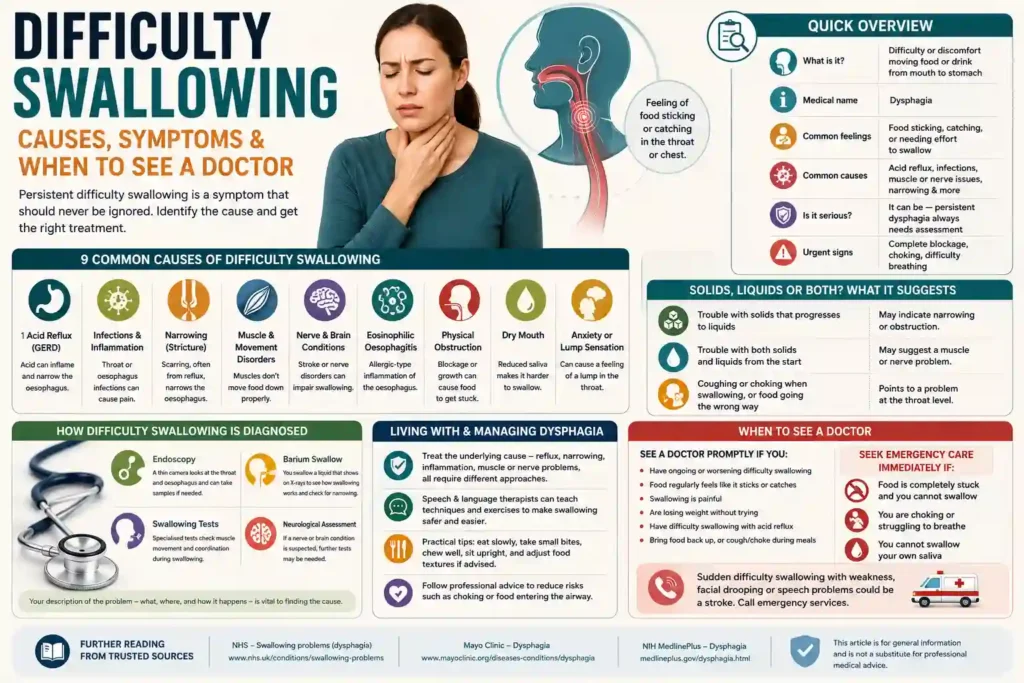
Difficulty Swallowing: 9 Causes of Dysphagia & When to Worry Swallowing is something we do thousands of times a day without a moment’s thought — until it stops working smoothly. When food or drink suddenly feels like it sticks, catches, or takes real effort to get down, it is unsettling in a way few symptoms are, because it interferes with something so fundamental. That difficulty, known medically as dysphagia, is a symptom that always deserves attention, ranging from causes that are simple and temporary to some that need prompt medical assessment. The important thing to understand is that persistent difficulty swallowing is not something to ignore or push through. While an occasional sensation of food catching when you eat too fast is usually harmless, ongoing or worsening trouble swallowing is a signal worth taking seriously — because identifying the cause matters, and some causes need timely treatment. This is a symptom where erring on the side of getting it checked is genuinely wise. This guide covers the common causes of difficulty swallowing, the warning signs that need urgent care, and when to see a doctor. Quick Overview Question Short answer What is it? Difficulty or discomfort moving food or drink from mouth to stomach Medical name Dysphagia Common feelings Food sticking, catching, or needing effort to swallow Common causes Acid reflux, infections, muscle or nerve issues, narrowing Is it serious? It can be — persistent dysphagia always needs assessment Urgent signs Complete blockage, choking, difficulty breathing Key message Ongoing difficulty swallowing should always be checked What Is Dysphagia? Dysphagia is the medical term for difficulty swallowing. Swallowing is a surprisingly complex process involving the coordinated action of many muscles and nerves, moving food and drink from the mouth, through the throat, down the oesophagus, and into the stomach. A problem at any point along this journey can cause difficulty. Doctors often distinguish between difficulty at the top — trouble getting the swallow started, sometimes with coughing or choking, which points to the throat and its muscles or nerves — and difficulty lower down, a sensation of food sticking in the chest after swallowing, which points to the oesophagus. This distinction helps identify where the problem lies. Some people also experience painful swallowing, called odynophagia, which can occur with or without difficulty. Because swallowing is so essential, and because persistent dysphagia can sometimes signal a condition needing treatment, it is a symptom that should always be assessed rather than ignored. Some causes are minor and temporary; others need timely attention, and only proper evaluation can tell them apart. 9 Common Causes of Difficulty Swallowing 1. Acid reflux (GERD). Long-standing acid reflux is a common cause. Over time, acid can inflame and, in some cases, narrow the oesophagus, making swallowing difficult. Reflux-related swallowing problems are one reason persistent reflux should be managed — see our guide on GERD symptoms. 2. Infections and inflammation. Infections of the throat or oesophagus, and inflammation from various causes, can make swallowing painful or difficult, usually temporarily. A severe sore throat, for instance, can make swallowing uncomfortable. 3. A narrowing of the oesophagus (stricture). Scarring, often from long-term acid reflux, can narrow the oesophagus, causing food to feel like it sticks. This tends to affect solid foods more than liquids at first. 4. Muscle and movement disorders. Conditions affecting the muscles that move food down the oesophagus can disrupt the coordinated waves of contraction needed for swallowing, causing food to move poorly. 5. Nerve and brain conditions. Because swallowing relies on nerve control, conditions affecting the nervous system — such as a stroke or certain neurological disorders — can impair swallowing, sometimes with coughing or choking during meals. 6. Eosinophilic oesophagitis. An allergic-type inflammation of the oesophagus, increasingly recognised, that can cause food to stick, particularly in younger adults, and is often linked with other allergic conditions. 7. A physical obstruction. Something partially blocking the passage, including in some cases a growth, can cause difficulty swallowing. This possibility is exactly why persistent or worsening dysphagia always needs assessment. 8. Dry mouth. Reduced saliva, whether from medications, certain conditions, or dehydration, can make swallowing harder simply because food is not adequately moistened. 9. Anxiety and the sensation of a lump. A feeling of a lump in the throat, sometimes linked to anxiety or reflux, can create a sensation of difficulty, though true dysphagia — food genuinely sticking — should always be distinguished from this and assessed. Solids, Liquids, or Both? What It Suggests A useful clue lies in whether you struggle with solids, liquids, or both: These patterns help a doctor work out where the problem lies, so noting your own experience is genuinely useful information to bring to an appointment. How Difficulty Swallowing Is Diagnosed Because dysphagia has so many possible causes, a doctor uses your description of the problem alongside tests to identify what is going on. Your account of the symptom is genuinely valuable here — whether solids or liquids are affected, whether food sticks high in the throat or lower in the chest, whether swallowing is painful, and whether the problem is getting worse all help point towards the cause. Depending on what is suspected, a doctor may recommend investigations such as an endoscopy, where a thin flexible camera is passed down to look directly at the throat and oesophagus and take samples if needed; a barium swallow, where you swallow a liquid that shows up on X-rays to reveal how swallowing is working and whether there is any narrowing; or specialised tests of the swallowing muscles and their coordination. Where a nerve or brain cause is suspected, further neurological assessment may be involved. This range of tests reflects why persistent difficulty swallowing warrants medical evaluation rather than guesswork — the cause could lie in the structure of the oesophagus, the muscles and nerves that control swallowing, inflammation, or an obstruction, and each is investigated and treated differently. Getting the right diagnosis is what leads to the right treatment, and for a symptom
Chronic Cough Causes: 10 Reasons & Effective Relief Tips
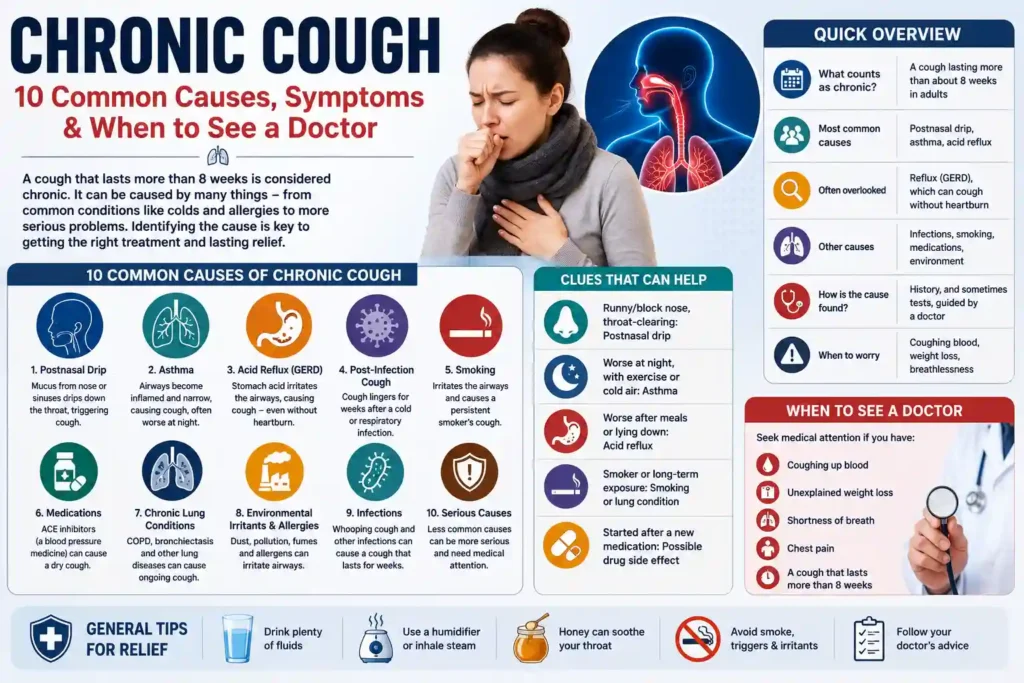
Chronic Cough Causes: 10 Reasons & Effective Relief Tips A cough that lingers long after a cold has cleared is one of the most wearing symptoms to live with. It interrupts your sleep, exhausts your chest, draws worried glances in quiet rooms, and refuses to respond to the cough syrups that usually help. When a cough drags on for weeks, it stops being the ordinary aftermath of an infection and becomes something worth understanding — because a persistent cough almost always has an identifiable cause, and the cause determines what will actually make it stop. The key fact to hold onto is that a chronic cough is a symptom, not a disease in itself. It is your body’s response to something irritating or inflaming the airways, and that “something” can range from the entirely benign to the more significant. The reassuring news is that the most common causes are treatable, and once the right one is identified and addressed, the cough usually settles. The frustration many people feel comes from treating the cough itself rather than its cause. This guide walks through the most common reasons for a chronic cough, how to start narrowing down yours, and the warning signs that mean it is time to see a doctor. Quick Overview Question Short answer What counts as chronic? A cough lasting more than about eight weeks in adults Most common causes Postnasal drip, asthma, acid reflux Often overlooked Reflux (GERD), which can cough without heartburn Other causes Infections, smoking, medications, environment How is the cause found? History, and sometimes tests, guided by a doctor When to worry Coughing blood, weight loss, breathlessness What Counts as a Chronic Cough? Coughs are grouped by how long they last. An acute cough lasts under a few weeks and is almost always due to a viral infection like a cold. A cough lasting several weeks is sometimes called subacute, often lingering after an infection. A chronic cough in adults is generally one that persists for more than about eight weeks — the point at which it is no longer just the tail end of an infection and deserves a proper look at what is driving it. This distinction matters because the approach changes. A short-lived cough after a cold usually needs only rest, fluids, and time, as covered in our guide on home remedies for cough. A chronic cough, by contrast, is a signal that something ongoing is irritating the airways, and identifying that cause is the route to relief. 10 Common Causes of a Chronic Cough 1. Postnasal drip (upper airway cough syndrome). One of the most common causes. Mucus from the nose and sinuses drips down the back of the throat, triggering a persistent cough. It often comes with a feeling of something at the back of the throat, frequent throat-clearing, or a blocked or runny nose. 2. Asthma. Asthma does not always cause obvious wheezing — in some people it shows mainly as a chronic cough, often worse at night, with exercise, or in cold air. This “cough-variant asthma” is a frequently missed cause. 3. Acid reflux (GERD). Acid flowing back up from the stomach can irritate the airways and trigger a chronic cough, sometimes without any classic heartburn — so-called silent reflux. This is a very common and under-recognised cause. Our guide on GERD symptoms explains how reflux can cause a cough even when heartburn is absent. 4. Lingering post-infection cough. Sometimes a cough persists for weeks after a respiratory infection has otherwise cleared, as the airways remain sensitive and inflamed. This usually settles on its own with time. 5. Smoking. Smoking is a major cause of chronic cough, irritating the airways directly. A persistent “smoker’s cough” is common, and a change in a long-standing smoker’s cough should always be assessed. 6. Certain medications. A particular class of blood pressure medicines, the ACE inhibitors, causes a dry cough in a notable minority of people who take them. If your cough began after starting a new medication, mention it to your doctor — but never stop a prescribed medication on your own. 7. Chronic lung conditions. Conditions such as COPD (often smoking-related) and bronchiectasis cause an ongoing cough, frequently with phlegm, and need medical management. 8. Environmental irritants and allergies. Dust, pollution, chemical fumes, and allergens can irritate the airways and cause a persistent cough, particularly with ongoing exposure. 9. Whooping cough and other infections. Some infections, including whooping cough, can cause a cough that lasts many weeks. Less commonly, other infections need to be considered, especially if there are other symptoms. 10. Less common but serious causes. Occasionally a chronic cough signals something more serious affecting the lungs or airways. This is why certain warning signs — such as coughing up blood, unexplained weight loss, or a persistent change in a long-standing cough — always warrant medical assessment. The “Big Three” and Why They Matter While the list above is long, in practice a large majority of chronic coughs in adults come down to three causes: postnasal drip, asthma, and acid reflux — alone or in combination. Doctors often focus on these first because they are so common and so treatable. What makes them tricky is that they do not always announce themselves obviously. Asthma can cough without wheezing, reflux can cough without heartburn, and postnasal drip can be subtle. This is why a chronic cough sometimes takes a little detective work, and why treating the suspected cause and seeing whether the cough improves is a recognised approach. It is also why guessing at the cause yourself is less reliable than having a doctor consider these systematically. How to Start Narrowing Down Your Cough Some clues can point towards the cause: Keeping a note of when the cough is worse, what makes it better or worse, and any accompanying symptoms genuinely helps a doctor identify the cause. Because more than one cause can coexist, this information is valuable. Dry Cough vs Productive Cough: What It Tells You The nature
Home Remedies for Constipation: 12 Natural Ways to Relief
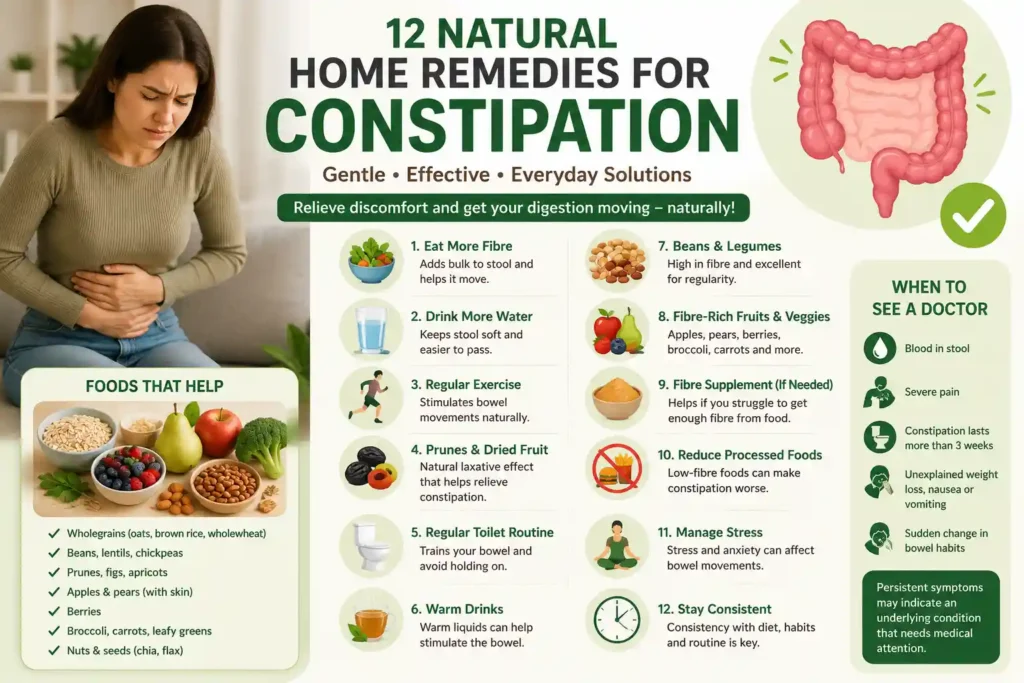
Home Remedies for Constipation: 12 Natural Ways to Relief Constipation is one of those health complaints people rarely talk about but almost everyone experiences at some point. The discomfort, the bloating, the straining, the feeling of never quite being finished — it is genuinely unpleasant, and it can quietly affect your mood and energy for days. The good news is that most constipation responds well to simple, natural measures you can start at home, and understanding what actually causes it makes those measures far more effective. At its heart, constipation usually comes down to a few everyday factors: not enough fibre, not enough fluid, too little movement, and sometimes ignoring the urge to go. Address these, and the situation often improves on its own. There is no need to reach immediately for strong laxatives, which are best kept for when gentler approaches fall short — and the natural remedies below tackle the root of the problem rather than just forcing a short-term result. This guide covers the most effective home remedies for constipation, how to use them well, and the signs that mean it is time to see a doctor rather than continue self-treating. Quick Overview Remedy How it helps More fibre Adds bulk and softens stool More water Keeps stool soft and moving Regular exercise Stimulates bowel movement Prunes and dried fruit Natural, gentle laxative effect A regular toilet routine Trains the bowel and avoids holding on Warm drinks Can stimulate the bowel Reducing certain foods Cutting back on low-fibre processed foods Why Constipation Happens Constipation means passing stools less often than is normal for you, or having hard, dry stools that are difficult or uncomfortable to pass. What counts as “normal” varies a lot between people, so it is defined relative to your own usual pattern rather than a fixed number. The most common causes are everyday and very fixable: a diet low in fibre, not drinking enough fluid, and too little physical activity. When there is not enough fibre and water, stool becomes hard and dry; when you move little, the bowel is less stimulated to push things along. Other contributors include ignoring the urge to go, changes in routine or travel, certain medications, stress, and some medical conditions. Because the common causes are so addressable, natural home remedies are genuinely effective for most constipation — targeting the underlying factors rather than just the symptom. 12 Home Remedies for Constipation 1. Eat more fibre. The single most effective long-term measure. Fibre adds bulk to stool and helps it move through the bowel. Good sources include wholegrains, fruits, vegetables, beans, lentils, nuts, and seeds. Increase fibre gradually to avoid bloating, and always with enough water. 2. Drink more water. Fibre works best with adequate fluid. Without enough water, extra fibre can actually make constipation worse, so the two go together. Staying well hydrated helps keep stool soft and easier to pass. 3. Move your body. Physical activity stimulates the natural muscle contractions that move stool through the bowel. Even a daily walk helps, and regular exercise is one of the most reliable ways to keep things regular. 4. Try prunes and dried fruit. Prunes are a well-known natural remedy for good reason — they contain fibre and a natural compound that has a gentle laxative effect. Other dried fruits like figs and apricots can help too. 5. Establish a regular toilet routine. The bowel responds to routine. Trying to go at the same time each day, often after a meal when the bowel is naturally more active, can help train it. Never ignore the urge to go, as holding on makes constipation worse. 6. Don’t rush or strain. Give yourself time and a relaxed setting. Straining is uncomfortable and can cause other problems. Raising your feet on a small stool while on the toilet, bringing your knees higher, can make passing stool easier for some people. 7. Have a warm drink. A warm drink, particularly in the morning, can stimulate the bowel for some people. Warm water or a caffeine-free warm drink is a gentle way to encourage movement. 8. Include beans and legumes. Lentils, chickpeas, and beans are excellent sources of fibre and are among the more effective foods for keeping the bowel regular. 9. Eat fibre-rich fruits and vegetables. Apples, pears, berries, broccoli, carrots, and leafy greens all add fibre and fluid. Pears and apples with their skin on are particularly helpful. 10. Consider a fibre supplement if needed. If you struggle to get enough fibre from food, a fibre supplement can help — taken with plenty of water. This is a gentler approach than stimulant laxatives. 11. Reduce low-fibre processed foods. Diets heavy in processed foods, white bread, and low-fibre snacks contribute to constipation. Shifting towards whole foods naturally increases fibre and improves regularity. 12. Manage stress and routine. Stress and disrupted routines, including travel, can affect the bowel. Keeping to regular meals, sleep, and movement, and managing stress, supports normal bowel function. Foods That Help With Constipation Fibre-rich foods to include Why they help Wholegrains — oats, brown rice, wholewheat Insoluble fibre adds bulk Beans, lentils, chickpeas High in fibre, keep things moving Prunes, figs, apricots Natural gentle laxative effect Apples and pears (with skin) Fibre and fluid Berries Fibre-rich and low in sugar Broccoli, carrots, leafy greens Fibre and nutrients Nuts and seeds — chia, flax Fibre and healthy fats A key point: increase fibre gradually and always with enough water. Adding a lot of fibre suddenly, or without enough fluid, can cause bloating and gas or even worsen constipation. A steady increase alongside good hydration is the way to get the benefit comfortably. What About Laxatives? Over-the-counter laxatives have their place for short-term relief when natural measures are not enough, but they are best used occasionally rather than relied upon. Different types work in different ways, and some are gentler than others. Because regular long-term use of certain laxatives without medical advice can cause problems, and because persistent constipation should be