Headache Causes: 12 Proven Reasons & How to Find Relief
Almost everyone gets headaches, and for most people they are an occasional, forgettable nuisance — a tight band of pressure after a long day, a dull ache that a glass of water and a rest sees off. But headaches are not all the same. They come in different types, with different causes, and understanding which kind you are dealing with makes a real difference to how you treat it and whether it is something to simply ride out or take more seriously.
The reassuring reality is that the vast majority of headaches are what doctors call “primary” headaches — tension headaches and migraines chief among them — which, while genuinely unpleasant, are not caused by any dangerous underlying condition. Only a small minority of headaches signal something that needs urgent attention, and these usually come with recognisable warning signs. Knowing the common causes helps you find relief for the everyday kind and spot the rare situations that need a doctor.
This guide covers the common causes of headaches, how to ease them, and the warning signs that mean it is time to seek help.
Quick Overview
| Question | Short answer |
|---|---|
| Most common types | Tension headaches and migraines |
| Common triggers | Stress, dehydration, poor sleep, eye strain, hunger |
| Usually serious? | No — most headaches are not dangerous |
| Easing them | Rest, hydration, pain relief, addressing triggers |
| Migraine features | Often one-sided, throbbing, with nausea or light sensitivity |
| When to worry | Sudden severe headache, headache with neurological signs |
Understanding Headaches
A headache is pain or discomfort in the head or face, and it can range from a mild ache to severe, disabling pain. Doctors divide headaches into two broad groups. Primary headaches — including tension headaches, migraines, and cluster headaches — are headaches that are the problem in themselves, not a symptom of another condition. These make up the vast majority. Secondary headaches are caused by another underlying issue, ranging from something minor like a cold or dehydration to, rarely, something more serious.
This distinction is reassuring, because it means most headaches, while painful, are not a sign of anything dangerous. Understanding the type and cause of your headache helps you treat it effectively — a tension headache, a migraine, and a dehydration headache each respond best to slightly different approaches. And knowing the warning signs of the rare serious headache means you can act appropriately without worrying unnecessarily about every ordinary ache.
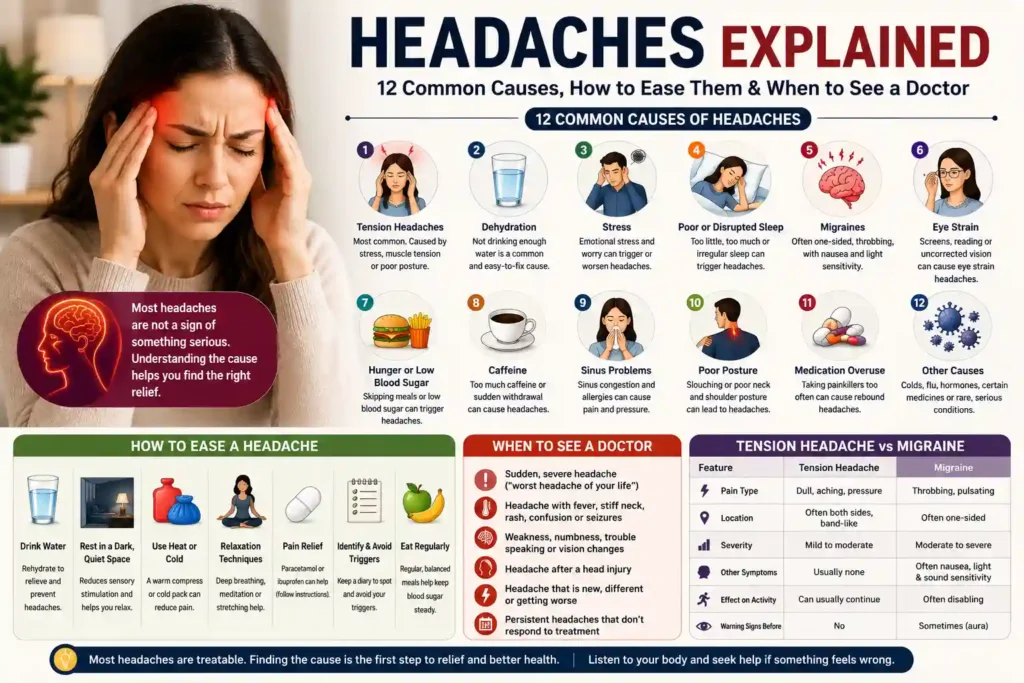
12 Common Causes of Headaches
1. Tension headaches. The most common type. These cause a dull, aching pain, often described as a tight band around the head, usually on both sides. They are frequently linked to stress, muscle tension, poor posture, and tiredness.
2. Dehydration. Not drinking enough fluid is a common and easily overlooked cause of headaches. A dehydration headache often eases once you rehydrate.
3. Stress. Stress is one of the biggest triggers of both tension headaches and migraines, partly through muscle tension and partly through its wider effects on the body.
4. Poor or disrupted sleep. Too little sleep, too much sleep, or irregular sleep patterns can all trigger headaches. The link between sleep and headaches runs in both directions.
5. Migraines. Migraines are a distinct and often severe type of headache, typically throbbing and often one-sided, frequently with nausea, and sensitivity to light and sound. Some people experience warning signs beforehand. Migraines have their own triggers and management.
6. Eye strain. Prolonged screen use, reading, or uncorrected vision problems can strain the eyes and trigger headaches, often felt around the eyes and forehead.
7. Hunger or low blood sugar. Skipping meals or going too long without eating can bring on a headache in some people, often eased by eating.
8. Caffeine. Both caffeine itself and caffeine withdrawal can cause headaches. People who regularly consume caffeine may get a headache if they suddenly cut back.
9. Sinus problems. Congestion and inflammation in the sinuses, often with a cold or allergies, can cause pain and pressure in the face and forehead, sometimes called a sinus headache.
10. Poor posture. Sitting hunched or with poor neck and shoulder posture for long periods can cause muscle tension that leads to headaches.
11. Medication overuse. Ironically, taking pain-relief medication too frequently for headaches can itself cause ongoing headaches, known as medication-overuse or rebound headaches. This is a recognised trap worth knowing about.
12. Other causes. Headaches can accompany infections like colds and flu, certain medications, hormonal changes, and, rarely, more serious conditions — which is why certain warning signs always warrant attention.
Tension Headache vs Migraine
Two of the most common headache types are worth telling apart, because they feel different and are managed differently.
| Feature | Tension headache | Migraine |
|---|---|---|
| Pain type | Dull, aching, pressure | Throbbing, pulsating |
| Location | Often both sides, band-like | Often one-sided |
| Severity | Mild to moderate | Moderate to severe |
| Other symptoms | Usually none | Often nausea, light and sound sensitivity |
| Effect on activity | Can usually continue | Often disabling |
| Warning signs before | No | Sometimes (aura) |
Recognising which you tend to get helps you respond appropriately. Tension headaches often respond to rest, hydration, addressing stress and posture, and simple pain relief. Migraines are their own condition, often needing specific management, and people who get frequent or severe migraines benefit from seeing a doctor. Our guide on related everyday symptoms, such as fatigue causes, covers overlapping triggers like poor sleep and stress.
How to Ease a Headache
For a common tension or everyday headache, these measures often help:
- Drink water. Rehydrating relieves dehydration headaches and supports recovery generally.
- Rest in a quiet, dark space. Reducing sensory input helps, especially with migraines.
- Apply a cold or warm compress. A cold compress on the forehead or a warm one on the neck eases some headaches.
- Address the trigger. If stress, hunger, eye strain, or poor posture is involved, tackling it helps both now and in future.
- Take a break from screens. Resting the eyes can ease eye-strain headaches.
- Gentle relaxation. Easing muscle tension in the neck and shoulders, and relaxation techniques, can help tension headaches.
- Use pain relief sparingly. Over-the-counter pain relief can ease headaches for adults, used as directed — but avoid taking it too frequently, to prevent medication-overuse headaches.
Most everyday headaches settle with these measures and a little time. Identifying and addressing your personal triggers is the most effective way to reduce how often they occur.
The Main Types of Headache Explained
Beyond tension headaches and migraines, it helps to understand the main headache types, since recognising yours guides how best to manage it.
Tension headaches are the most common, producing a dull, pressing pain like a tight band around the head, usually on both sides. They are typically mild to moderate, and are strongly linked to stress, muscle tension, poor posture, and tiredness. They usually respond well to rest, hydration, and addressing their triggers.
Migraines are a distinct neurological condition, not just a bad headache. They tend to cause throbbing, often one-sided pain that is moderate to severe, frequently with nausea and sensitivity to light and sound, and can be genuinely disabling. Some people get warning signs beforehand, such as visual disturbances. Migraines have their own triggers and often benefit from specific medical management.
Cluster headaches are less common but very severe, causing intense pain usually around one eye, occurring in clusters over a period. They are distinctive and need medical assessment.
Sinus headaches cause pain and pressure in the face and forehead, usually alongside sinus congestion from a cold or allergies, and ease as the underlying congestion clears.
Medication-overuse headaches develop from taking pain relief too often, creating a cycle of ongoing headaches. Recognising which type or types you experience is genuinely useful, because it directs you towards the most effective approach and helps you and your doctor manage them well.
Preventing Headaches
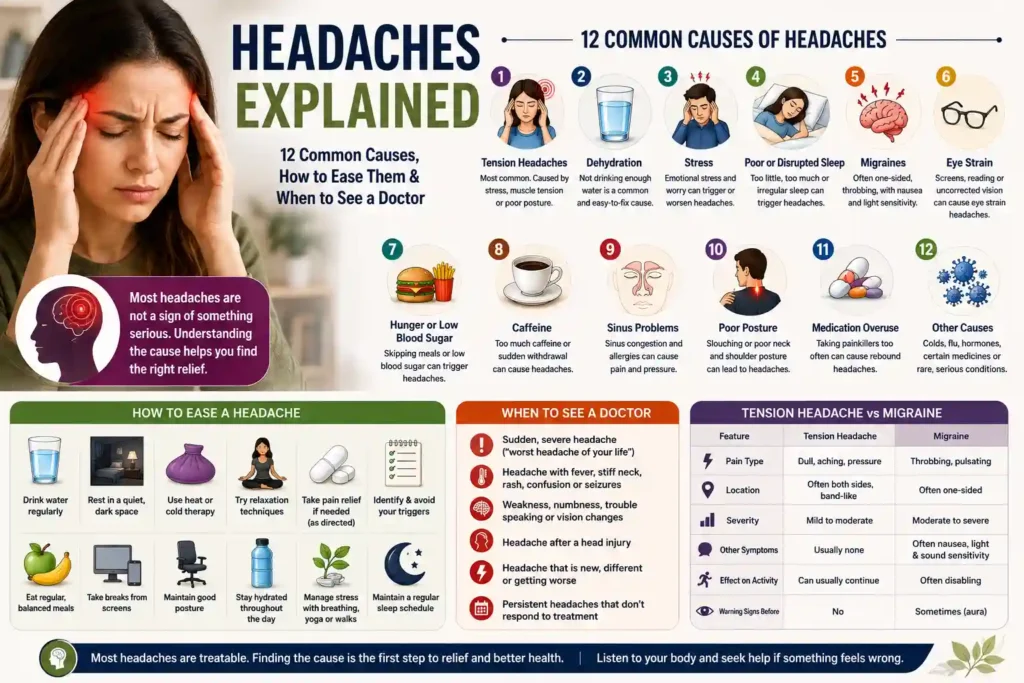
For anyone who gets frequent headaches, prevention is often more valuable than treating each one as it comes, and it centres on identifying and reducing your personal triggers.
Keeping a simple headache diary — noting when headaches occur and what preceded them, including food, sleep, stress, screen time, and for women the menstrual cycle — often reveals clear patterns. Once you know your triggers, you can address them: staying well hydrated through the day, keeping regular sleep patterns, eating regularly to avoid hunger headaches, managing stress, taking regular screen breaks, and maintaining good posture all help reduce how often headaches strike.
Being mindful of caffeine is worth a mention, since both too much and sudden withdrawal can trigger headaches; keeping intake moderate and consistent helps. And importantly, avoiding the overuse of pain-relief medication prevents the rebound headaches that can develop from taking it too frequently. For people whose headaches remain frequent or severe despite these measures, a doctor can help identify the type, look for specific triggers, and, particularly for migraines, discuss preventive treatment. The overall aim is to make headaches less frequent and less severe by tackling their causes rather than only reaching for relief once the pain has arrived.
When to See a Doctor
See a doctor if:
- Headaches are frequent, severe, or getting worse
- Headaches are disrupting your daily life or sleep
- You are using pain relief for headaches very often
- You have migraines that are frequent or hard to manage
- Your usual headache pattern changes noticeably
- Headaches are accompanied by other concerning symptoms
Seek emergency care immediately for a headache with any of these features, which can signal a serious problem:
- A sudden, severe headache that reaches maximum intensity within seconds or minutes (“thunderclap”)
- Headache with a stiff neck, high fever, and a rash
- Headache with confusion, drowsiness, or difficulty speaking
- Headache with weakness, numbness, or vision loss
- Headache after a significant head injury
- The worst headache of your life, or a headache unlike any before
These are medical emergencies. The NHS guidance on headaches explains when to seek help.
Final Thoughts
Headaches are so common that it is easy to lump them all together, but understanding that they come in different types with different causes changes how effectively you can deal with them. The great majority are primary headaches — tension headaches and migraines — which, while genuinely unpleasant, are not caused by anything dangerous and respond well to hydration, rest, addressing triggers like stress and sleep, and sensible use of pain relief.
The balanced approach is to treat everyday headaches with these simple measures and, importantly, to identify and reduce your personal triggers so they happen less often. At the same time, it is worth knowing the small number of warning signs — a sudden severe headache, one with neurological symptoms or a stiff neck and fever, or a headache after injury — that mean urgent care is needed. For the ordinary headaches most people experience, though, understanding the cause and addressing it is usually all it takes to find relief and keep them from ruling your days.
Medical disclaimer: This article is for general educational information and is not a substitute for professional medical advice, diagnosis, or treatment. Seek emergency care for a sudden severe headache, or a headache with neurological symptoms, stiff neck and fever, or following a head injury.
Frequently Asked Questions
What are the most common causes of headaches? The most common causes are tension headaches, often linked to stress, muscle tension, and tiredness, and migraines. Dehydration, poor sleep, eye strain, hunger, caffeine, sinus problems, and poor posture are also common triggers. Most headaches are not caused by anything dangerous.
What is the difference between a tension headache and a migraine? A tension headache is a dull, aching, band-like pressure, often on both sides and usually mild to moderate. A migraine is typically throbbing, often one-sided, moderate to severe, and frequently comes with nausea and sensitivity to light and sound, often disrupting activity.
How can I get rid of a headache naturally? Drinking water, resting in a quiet dark space, applying a cold or warm compress, addressing triggers like stress or hunger, taking a break from screens, and relaxing tense neck and shoulder muscles all help. Identifying and reducing your triggers prevents headaches from recurring.
Can dehydration cause headaches? Yes. Not drinking enough fluid is a common and often overlooked cause of headaches, and a dehydration headache usually eases once you rehydrate. Staying well hydrated through the day is a simple way to prevent this type of headache.
Why do I get headaches so often? Frequent headaches can result from ongoing triggers like stress, poor sleep, dehydration, eye strain, or caffeine, or from frequent migraines. Taking pain relief too often can also cause medication-overuse headaches. Frequent or worsening headaches are worth discussing with a doctor.
When should I worry about a headache? Seek emergency care for a sudden severe “thunderclap” headache, a headache with a stiff neck and fever, confusion, difficulty speaking, weakness, numbness, or vision changes, a headache after a head injury, or the worst headache of your life. These can signal a serious problem.
Can pain relief medication cause headaches? Yes. Taking pain-relief medication too frequently for headaches can cause ongoing medication-overuse or rebound headaches. This is why pain relief should be used sparingly, and why frequent reliance on it for headaches is worth discussing with a doctor.
Can stress cause headaches? Yes. Stress is one of the biggest triggers of both tension headaches and migraines, partly through the muscle tension it creates in the neck, shoulders, and scalp, and partly through its wider effects on the body. Managing stress can noticeably reduce how often these headaches occur.
Why do I wake up with a headache? Waking with a headache can relate to poor sleep quality, too much or too little sleep, teeth grinding, sleep apnoea, dehydration overnight, or caffeine withdrawal. If morning headaches are frequent, it is worth looking at your sleep habits and mentioning them to a doctor.
Are headaches ever a sign of something serious? The vast majority of headaches are not dangerous. However, a small minority signal something serious, usually with warning signs — a sudden severe headache, one with a stiff neck and fever, confusion, weakness, vision changes, or a headache after a head injury. These need emergency assessment, while ordinary headaches do not.