Calcium Benefits: 8 Proven Ways It Supports Your Health
Most people know calcium as “the bone mineral,” and for good reason — the vast majority of the body’s calcium is stored in the bones and teeth, giving them their strength and structure. But calcium’s role goes well beyond the skeleton. This single mineral is quietly involved in some of the most essential processes keeping you alive, from the beating of your heart to the contraction of every muscle and the firing of every nerve.
That wider importance is exactly why the body guards its calcium levels so carefully. If you do not take in enough, the body will draw calcium out of the bones to keep the blood level steady for these vital functions — which protects the heart and nerves in the short term but weakens the bones over time. Getting enough calcium from your diet, then, is not just about strong bones; it is about keeping the whole system supplied without your skeleton paying the price.
This guide covers what calcium actually does, its proven benefits, the best food sources, how much you need, and how to meet your needs safely.
Quick Overview
| Question | Short answer |
|---|---|
| What is calcium? | An essential mineral, mostly stored in bones and teeth |
| Key roles | Bones, teeth, muscles, nerves, heart, blood clotting |
| Best food sources | Dairy, leafy greens, fortified foods, tinned fish with bones |
| Works with | Vitamin D, which is needed to absorb calcium |
| Who’s at risk of low calcium? | Those avoiding dairy, older adults, some medical conditions |
| Can you take too much? | Yes — excess from supplements can cause problems |
Why Calcium Matters So Much
Calcium is the most abundant mineral in the body, and around 99% of it is stored in the bones and teeth, where it provides structure and strength. The remaining small fraction, circulating in the blood and tissues, is disproportionately important — it is essential for muscle contraction, nerve signalling, blood clotting, and a steady heartbeat.
The body keeps blood calcium within a tight range at all costs, because these functions cannot tolerate much variation. If dietary calcium falls short, hormones signal the bones to release calcium into the blood to maintain that level. This is a clever short-term protective system, but relied on long-term it depletes the bones, which is how chronic low calcium contributes to weak, fragile bones later in life. This is also why calcium and vitamin D are so closely linked: vitamin D is needed for the body to absorb calcium from food, so a shortage of either undermines bone health. Our guide on vitamin D deficiency symptoms explains that partnership in more detail.
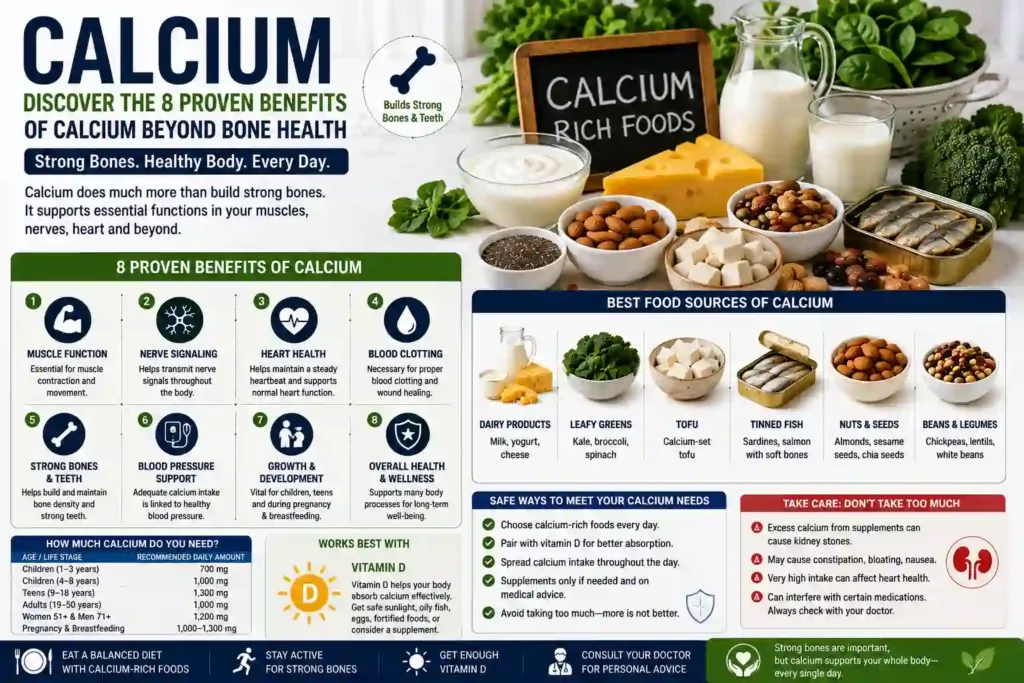
8 Proven Benefits of Calcium
1. Builds and maintains strong bones. Calcium’s best-known role. It gives bones their density and strength, and adequate intake throughout life — especially during childhood, adolescence, and older age — supports peak bone mass and helps protect against bone loss.
2. Supports healthy teeth. Just as it strengthens bones, calcium is a key component of teeth, contributing to their structure and helping maintain dental health.
3. Enables muscle function. Every muscle contraction, from lifting a cup to the beating of your heart, depends on calcium. It is essential for the process by which muscles contract and relax.
4. Supports nerve signalling. Calcium plays a crucial role in transmitting signals between nerves and the rest of the body, making it essential for the nervous system to function properly.
5. Helps blood clot normally. Calcium is one of the factors the body needs to form blood clots, an essential process for healing wounds and preventing excessive bleeding.
6. Maintains a steady heartbeat. The heart is a muscle, and its rhythmic contractions depend on calcium. Stable calcium levels help support normal heart function.
7. May support healthy blood pressure. Adequate calcium, as part of an overall balanced diet, is associated with healthy blood pressure, and it features in dietary patterns recommended for blood pressure such as the DASH approach. Our guide on lowering blood pressure naturally covers this pattern.
8. Supports development in children and pregnancy. Calcium is vital during periods of growth — in children and teenagers building their skeletons, and during pregnancy and breastfeeding, when demand rises to support the baby.
Signs You Might Be Low in Calcium
Because the body draws on bone stores to keep blood calcium steady, deficiency can be quiet at first. Over time, low calcium can contribute to:
- Weakened bones and higher fracture risk over the long term
- Muscle cramps or spasms
- Numbness or tingling in the fingers
- Brittle nails
- In severe cases, abnormal heart rhythms
These signs overlap with other conditions, and long-term bone loss in particular is silent until a fracture occurs, which is why meeting your calcium needs steadily over life matters more than waiting for symptoms.
Best Food Sources of Calcium
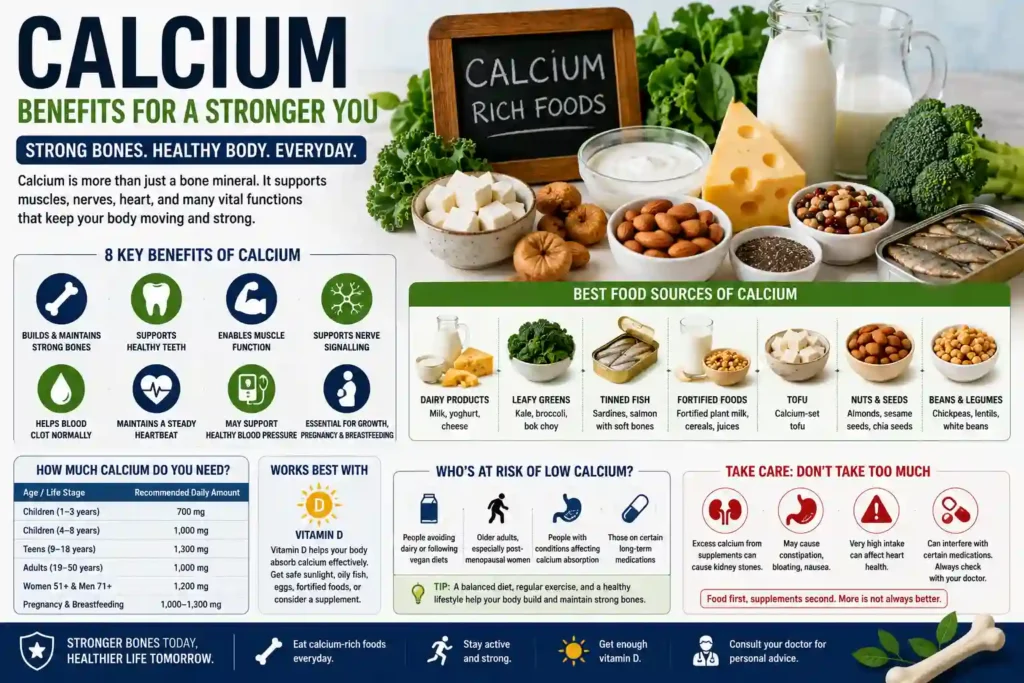
Food is the ideal way to meet your calcium needs. Good sources include:
- Dairy products — milk, yoghurt, and cheese are rich, well-absorbed sources
- Fortified foods — many plant milks, cereals, and juices have calcium added
- Leafy green vegetables — such as kale and broccoli (though spinach’s calcium is less well absorbed)
- Tinned fish with soft bones — sardines and salmon
- Tofu set with calcium
- Beans, lentils, and chickpeas
- Nuts and seeds — particularly almonds and sesame seeds
For those who avoid dairy, combining fortified foods with leafy greens, tinned fish, calcium-set tofu, and nuts makes it entirely possible to meet calcium needs from plant and non-dairy sources. Pairing adequate calcium with enough vitamin D — from sunlight, food, or a supplement — ensures the calcium is actually absorbed.
How Much Calcium Do You Need?
Calcium needs vary by age and life stage, being higher during the growth of childhood and adolescence, and again in older adults, as well as during pregnancy and breastfeeding. Most people can meet their needs through a balanced diet that includes good calcium sources, and food is the preferred route.
The important balance to strike is getting enough without overdoing it. While deficiency harms the bones over time, very high intakes — usually from supplements rather than food — are not beneficial and can cause problems. The goal is adequacy, matched to your life stage, rather than as much as possible.
How to Take Calcium Safely
For most people, a balanced diet provides enough calcium without supplements. When supplements are considered — for those who struggle to get enough from food, or on medical advice — a few points matter:
- Food first. Dietary calcium is the safest and preferred source, and it comes with other nutrients.
- Do not overdo supplements. Very high calcium intake from supplements has been linked with problems including kidney stones, and possibly other effects, so more is not better.
- Pair with vitamin D. Since vitamin D is needed to absorb calcium, adequate vitamin D matters alongside it.
- Split larger doses. The body absorbs calcium better in smaller amounts, so if supplementing, spreading intake can help.
- Check interactions. Calcium supplements can interfere with the absorption of certain medications, so spacing and advice matter.
The safest approach is to prioritise calcium-rich foods and to use supplements thoughtfully and ideally with professional advice, rather than taking high doses routinely. The NHS guidance on calcium sets out recommended amounts.
Calcium Across Your Lifetime
One of the most useful ways to understand calcium is to see it as a lifelong bank account for your bones. What you do at each stage of life affects how strong your skeleton is later.
During childhood and adolescence, the body is actively building bone, and this is the crucial window for laying down peak bone mass — the maximum bone density you will reach. Getting enough calcium and vitamin D during these growing years, along with weight-bearing activity, helps build the strongest possible skeleton, which acts as a reserve for later life. This is why calcium matters so much for children and teenagers, even though bone problems feel a lifetime away.
In adulthood, the focus shifts to maintaining that bone mass and slowing its natural, gradual decline. Adequate calcium, vitamin D, and regular activity all help preserve the bone you built earlier. Then, in older age — and particularly for women after menopause, when hormonal changes accelerate bone loss — calcium becomes important for limiting how quickly bone density declines, reducing the long-term risk of fragile bones and fractures.
Pregnancy and breastfeeding are another period of increased demand, as the body supports the baby’s developing skeleton. Seeing calcium this way — as a lifelong investment rather than a concern only for the elderly — helps explain why steady, adequate intake matters at every stage, not just when problems appear.
Who Is Most at Risk of Low Calcium
While many people meet their calcium needs through a normal diet, certain groups are more likely to fall short and benefit from paying closer attention.
People who avoid dairy — whether through lactose intolerance, a vegan diet, or personal preference — are among the most at risk, since dairy is such a concentrated and well-absorbed source. With planning around fortified foods, leafy greens, tinned fish, and calcium-set tofu, these individuals can meet their needs, but it requires more deliberate choices. Older adults are another group at risk, both because intake sometimes declines and because the body becomes less efficient at absorbing calcium with age.
Postmenopausal women face accelerated bone loss due to hormonal changes and are often advised to pay particular attention to calcium and vitamin D. People with certain medical conditions affecting absorption, such as some gut disorders, and those on particular long-term medications, may also be prone to low calcium. If you fall into one of these groups, it is worth discussing your calcium intake and bone health with your doctor rather than either ignoring it or reaching straight for high-dose supplements.
Common Myths About Calcium
A few persistent myths lead people astray, so they are worth clearing up. One is that only older people, or only women, need to worry about calcium — in reality, building strong bones happens in childhood and adolescence, making calcium important across all ages and both sexes. Another is that more calcium is always better; in fact, very high intakes from supplements offer no extra benefit and can cause problems, so adequacy rather than excess is the goal. A third is that you cannot get enough calcium without dairy, when in truth fortified foods, leafy greens, tinned fish, tofu, and nuts can meet needs with planning. Understanding these realities helps you make sensible choices rather than either neglecting calcium or over-supplementing.
When to See a Doctor
Consider speaking to a doctor if:
- You avoid dairy and are unsure whether you get enough calcium
- You have a condition affecting calcium absorption or bone health
- You experience muscle cramps, numbness, or tingling that concerns you
- You are considering calcium supplements, especially at higher doses
- You are pregnant, breastfeeding, or postmenopausal and concerned about your intake
A doctor can advise whether supplementation is appropriate and check for any underlying issue affecting your calcium or bones.
Final Thoughts
Calcium may be famous for bones, but its quiet work extends to your muscles, nerves, heart, and blood — which is why the body protects its levels so fiercely, even at the expense of your skeleton when intake falls short. That single fact reframes calcium from a bone-only concern to a whole-body essential, and it explains why steady, adequate intake throughout life matters so much.
The balanced takeaway is reassuringly simple: prioritise calcium-rich foods like dairy, fortified products, leafy greens, tinned fish, and nuts; ensure enough vitamin D so that calcium is absorbed; and match your intake to your life stage rather than chasing high-dose supplements. Get that right, and calcium does its wide-ranging work in the background — keeping your bones strong and your body running as it should.
Medical disclaimer: This article is for general educational information and is not a substitute for professional medical advice, diagnosis, or treatment. Consult a qualified healthcare provider before taking calcium supplements, particularly at high doses.
Frequently Asked Questions
What are the main benefits of calcium? Calcium builds and maintains strong bones and teeth, enables muscle contraction, supports nerve signalling and a steady heartbeat, helps blood clot normally, and is vital during growth and pregnancy. It is essential for far more than bone health alone.
What foods are high in calcium? Dairy products like milk, yoghurt, and cheese are rich, well-absorbed sources. Fortified plant milks and cereals, leafy greens, tinned fish with soft bones, calcium-set tofu, beans, and nuts also provide calcium, making it possible to meet needs without dairy.
How much calcium do I need per day? Needs vary by age and life stage, being higher in childhood, adolescence, older age, and during pregnancy and breastfeeding. Most people can meet their needs through a balanced diet, and food is the preferred source over supplements.
Can you take too much calcium? Yes. Very high calcium intake, usually from supplements rather than food, can cause problems including kidney stones and is not beneficial. The goal is adequacy matched to your life stage, not as much as possible, so supplements should be used thoughtfully.
Do I need vitamin D with calcium? Yes. Vitamin D is needed for the body to absorb calcium from food, so adequate vitamin D matters alongside calcium for bone health. A shortage of either undermines the benefit, which is why the two are so closely linked.
Can I get enough calcium without dairy? Yes, with planning. Fortified plant milks and cereals, leafy greens, tinned fish with bones, calcium-set tofu, beans, and nuts can together meet calcium needs. Pairing them with enough vitamin D ensures the calcium is properly absorbed.
What are the signs of low calcium? Over time, low calcium can contribute to weakened bones, muscle cramps or spasms, numbness or tingling in the fingers, and brittle nails, with abnormal heart rhythms in severe cases. Long-term bone loss is silent, which is why steady intake matters.
Is calcium important for children? Yes, very. Childhood and adolescence are the key window for building peak bone mass — the maximum bone density the body reaches. Adequate calcium and vitamin D during these years, along with activity, help build the strongest possible skeleton as a reserve for later life.
Does calcium help with blood pressure? Adequate calcium, as part of an overall balanced diet, is associated with healthy blood pressure and features in dietary patterns recommended for it, such as the DASH approach. It works as part of the whole diet rather than as a standalone treatment.