How to Get Rid of Hives: Fast Relief and Long-Term Treatment That Works
You wake up, glance in the mirror, and there they are — raised pink patches across your chest that were not there when you went to bed. They itch. You press one and it fades to white, then flushes back. An hour later that patch has disappeared entirely, but two new ones have shown up on your forearm.
That travelling, shape-shifting quality is the signature of hives, and it is also what makes them so unsettling. Most rashes stay put. Hives behave more like weather moving across the skin. Roughly one in five people will experience them at some point, and for the majority it is a brief, harmless episode that clears within a few days.
But not always. Some people live with hives for months. Some develop swelling of the lips or eyelids alongside them. And in a small number of cases, hives are the opening act of a serious allergic reaction that needs emergency care within minutes.
This guide walks through all of it — what hives actually are at a cellular level, why they appear, what medicine can do, and where herbal and home approaches genuinely fit in versus where they are oversold.
Quick Overview
| Question | Short answer |
|---|---|
| What are they? | Raised, itchy welts caused by histamine release in the skin |
| Medical name | Urticaria |
| Typical appearance | Pink, red, or skin-coloured raised patches that blanch when pressed |
| How long does one welt last? | Usually under 24 hours; often just a few hours |
| Acute vs chronic | Acute = under 6 weeks; chronic = 6 weeks or longer |
| Most common causes | Viral infections, foods, medications, insect stings, physical triggers |
| First-line treatment | Non-drowsy (second-generation) antihistamines |
| ICD-10 code | L50 (with subcodes such as L50.0 allergic, L50.1 idiopathic, L50.8 other) |
| Emergency signs | Trouble breathing, throat tightness, tongue swelling, dizziness, vomiting |
What Are Hives on Skin?
Hives are raised patches of swollen skin that appear when a chemical called histamine leaks into the upper layers of the skin. Doctors call the condition urticaria, and the individual bumps are called wheals.
Here is what is happening underneath. Scattered throughout your skin are immune cells called mast cells, each one loaded with tiny granules of histamine and other inflammatory chemicals. Normally they sit quietly. When something activates them — an allergen, an infection, pressure, cold, or an internal immune signal — they degranulate, dumping their contents into the surrounding tissue.
Histamine does two things immediately. It makes nearby small blood vessels leaky, so fluid seeps out into the skin and creates the raised, puffy welt. And it stimulates sensory nerve endings, which is why the itch is so intense and so hard to ignore.
That leaked fluid gets reabsorbed within hours, which explains the most distinctive feature of hives: individual welts move. A wheal that appears on your shoulder at noon may be gone by five o’clock, while fresh ones bloom elsewhere. If a spot stays fixed in the same place for more than 24 hours, that is a clue pointing away from ordinary hives and towards something else — more on that below.
Hives versus angioedema
The same process can happen deeper down, in the lower dermis and subcutaneous tissue. When it does, you get angioedema — swelling rather than welts, typically around the eyelids, lips, hands, feet, or genitals. It feels more like tightness or burning than itching.
Angioedema shows up alongside hives in roughly 40% of people with chronic urticaria. On its own it is usually harmless, but swelling of the tongue or throat is a medical emergency.
What Do Hives Look Like?
Hives are visually variable, which is part of why people misidentify them. Common features:
- Raised welts with clearly defined edges, ranging from a few millimetres to palm-sized patches
- Colour that is pink or red on lighter skin, and often skin-coloured, purplish, or slightly darker than surrounding skin on brown and Black skin — the raised texture is a more reliable clue than colour
- Blanching — press a welt with your fingertip and the centre turns pale, then refills when you release
- Merging, where separate welts join into large irregular maps with wavy borders
- Ring shapes, with a pale centre and a raised red rim, which parents often mistake for ringworm
- Intense itch that tends to worsen at night and with heat
One useful home test is the circle test. Trace around a welt with a skin-safe pen, then check that outline six and twelve hours later. If the welt has faded or moved out of its circle, it is behaving like typical urticaria. If it is still sitting inside the same outline a day later, mention that to your doctor.
Common Symptoms
Beyond the welts themselves, people commonly report:
- Itching that ranges from mild to genuinely sleep-destroying
- A burning or stinging quality, especially with heat or friction
- Symptoms flaring in the evening and overnight
- Welts appearing exactly where clothing presses — waistbands, bra straps, sock elastic
- Deeper swelling of lips, eyelids, hands, or feet
- Fatigue, low mood, and poor concentration in long-running cases
That last point is worth sitting with. Studies consistently find that chronic urticaria damages quality of life about as much as coronary artery disease does, largely through sleep disruption. If your hives are affecting your work or your rest, that is a legitimate medical reason to seek treatment — not something to tough out.
Warning symptoms that require emergency care
Call emergency services immediately if hives appear together with:
- Difficulty breathing, wheezing, or a tight throat
- Swelling of the tongue, lips, or inside of the mouth
- A hoarse voice or trouble swallowing
- Dizziness, fainting, or a racing pulse
- Sudden vomiting, cramping abdominal pain, or diarrhoea
- A sense that something is seriously wrong
These suggest anaphylaxis. If you carry an epinephrine auto-injector, use it first, then call for help. Antihistamines are not a substitute for epinephrine in anaphylaxis.
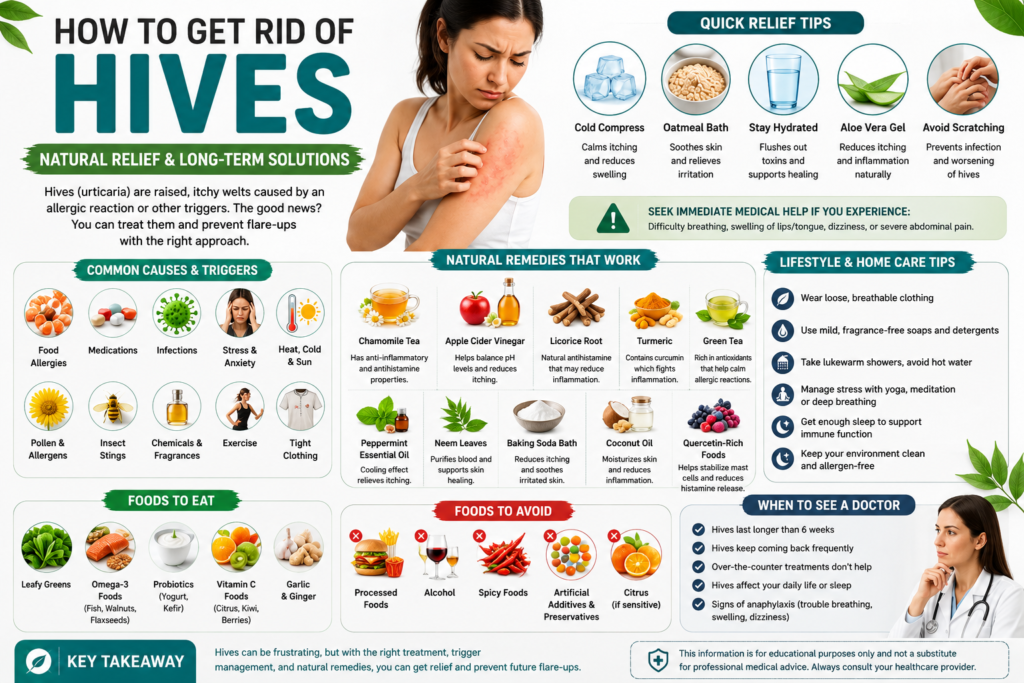
Causes and Risk Factors
Hives are a reaction pattern, not a single disease, which is why so many different things can produce them. For a fuller breakdown, see our detailed guide on what causes hives and how to identify your trigger.
Infections
This is the leading cause of sudden hives, particularly in children — and it surprises most people. Ordinary viral illnesses (colds, stomach bugs, sore throats) frequently produce hives while the immune system is revved up. Bacterial infections such as strep throat and urinary tract infections can do the same. The hives typically resolve as the infection clears.
Foods
Genuine food-triggered hives usually appear within two hours of eating, and the same food reliably produces the same result. The usual suspects are shellfish, tree nuts, peanuts, eggs, cow’s milk, wheat, soy, and sesame.
A caution here: people often blame food when the timing does not actually fit. If your hives started on a Tuesday and you spend the week scrutinising every meal, you will find a “culprit” whether or not one exists. Reaction within two hours, repeatable — that is the standard worth applying.
Medications
- NSAIDs — aspirin, ibuprofen, naproxen. These can trigger hives directly and also worsen existing urticaria in a substantial minority of patients.
- Antibiotics, especially penicillins and sulfa drugs
- ACE inhibitors (blood pressure medications ending in -pril), which classically cause angioedema rather than welts, sometimes after years of uneventful use
- Opioid painkillers, which release histamine through a non-allergic route
Never stop a prescribed medication on your own. Report the reaction to your prescriber and let them manage the switch.
Physical and environmental triggers
These produce a group called inducible urticaria, where a specific physical stimulus reliably reproduces the welts:
| Type | Trigger |
|---|---|
| Dermographism | Scratching or firm stroking of the skin |
| Cold urticaria | Cold air, cold water, swimming |
| Cholinergic urticaria | Rise in body temperature — exercise, hot showers, spicy food, anxiety |
| Delayed pressure urticaria | Sustained pressure such as sitting, carrying bags, tight straps |
| Solar urticaria | Sunlight exposure |
| Aquagenic urticaria | Water contact regardless of temperature |
Stress
Stress deserves an honest framing. It rarely creates hives out of nothing, but it lowers the threshold at which mast cells fire and worsens the itch–scratch cycle. Many people with chronic urticaria notice clear flares during exams, bereavement, or work crises. Our article on stress hives and how to break the flare cycle covers this relationship in depth.
Autoimmune activity
In chronic cases where no external trigger is ever found, a large proportion of patients turn out to have autoantibodies that activate their own mast cells. This is why chronic hives cluster with thyroid disease, and why an unremarkable allergy test does not mean nothing is happening.
Other triggers
Insect stings, latex, plant contact, blood transfusions, and certain contrast dyes round out the list.
Different Types of Hives
| Type | Duration | Typical picture |
|---|---|---|
| Acute urticaria | Under 6 weeks | Sudden onset, often after infection or a clear exposure; resolves on its own |
| Chronic spontaneous urticaria | 6 weeks or longer | Welts come and go most days with no identifiable external trigger |
| Chronic inducible urticaria | Ongoing | Reliably reproduced by a specific physical stimulus |
| Urticarial vasculitis | Variable | Welts last over 24 hours, feel painful rather than itchy, may bruise |
| Contact urticaria | Minutes | Welts confined to the area that touched a substance |
The acute–chronic distinction matters most, because it changes the entire investigative approach. Acute hives rarely need a workup. Chronic hives do. If yours have passed the six-week mark, our guide to managing chronic hives long term explains what to expect from that process.
Urticarial vasculitis is the important mimic. When welts stay fixed for more than a day, hurt more than they itch, and leave a bruise or brown stain behind, the underlying problem is inflammation of small blood vessels rather than simple histamine release. It needs a skin biopsy and different treatment — read more in our article on urticarial vasculitis versus ordinary hives.
How Hives Are Diagnosed
Most of the diagnosis happens through conversation, not testing. A clinician will ask how long each individual welt lasts, when the episodes started, what medications and supplements you take, whether swelling accompanies the welts, and whether anything reliably brings them on.
They may also stroke your forearm firmly with a blunt edge to check for dermographism, or apply an ice cube to test for cold urticaria.
For acute hives, extensive testing is usually unnecessary and often misleading. Broad allergy panels ordered without a matching history throw up incidental positives that send people down months of pointless dietary restriction.
For chronic hives lasting beyond six weeks, guidelines from professional dermatology and allergy bodies suggest a limited, targeted workup: a full blood count, an inflammatory marker such as CRP or ESR, and thyroid antibodies. Further investigation is driven by specific clues in the history — targeted allergy testing where a real-world exposure pattern exists, and a skin biopsy where vasculitis is suspected. The American Academy of Dermatology’s hives resource outlines this stepwise approach for patients.
Keeping a symptom diary for two to four weeks before your appointment is genuinely one of the most useful things you can do. Record the date, time of onset, body location, what you ate in the preceding few hours, medications taken, sleep quality, stress level, and any illness.
Conventional Medical Treatment
Second-generation antihistamines
These are the backbone of treatment: cetirizine, loratadine, fexofenadine, levocetirizine, and desloratadine. They block the H1 histamine receptor without crossing meaningfully into the brain, so they cause far less sedation than older options.
Two practical points that people frequently get wrong:
Take them regularly, not reactively. Daily dosing throughout a flare period prevents welts from forming. Waiting until you are already covered means chasing the reaction rather than preventing it.
Standard doses often are not enough. International urticaria guidelines endorse increasing the dose up to four times the standard amount in patients who do not respond — but this must be done under medical supervision, not by self-experimentation.
| Antihistamine | Onset | Sedation | Notes |
|---|---|---|---|
| Cetirizine | 1 hour | Mild | Strong effect; slight drowsiness in some |
| Fexofenadine | 1–2 hours | Minimal | Least sedating; avoid taking with fruit juice |
| Loratadine | 1–3 hours | Minimal | Well tolerated; slower onset |
| Levocetirizine | 1 hour | Mild | Often taken in the evening |
| Diphenhydramine | 30 minutes | Marked | First-generation; short-acting and sedating |
Older antihistamines like diphenhydramine still have a place for short-term night-time relief, though they are no longer first-line. Our guide on using Benadryl for hives safely covers appropriate use and its limits.
When antihistamines are not enough
- Leukotriene receptor antagonists such as montelukast, added on for some patients
- Short courses of oral corticosteroids for severe flares — days, not weeks, given the side effect burden of long-term use
- Omalizumab, an injected anti-IgE antibody, which has strong trial evidence in chronic spontaneous urticaria that has failed antihistamines
- Ciclosporin, an immunosuppressant reserved for resistant cases under specialist supervision
Full detail on the treatment ladder, including realistic timelines for each step, is in our article on how to get rid of hives fast and for good.
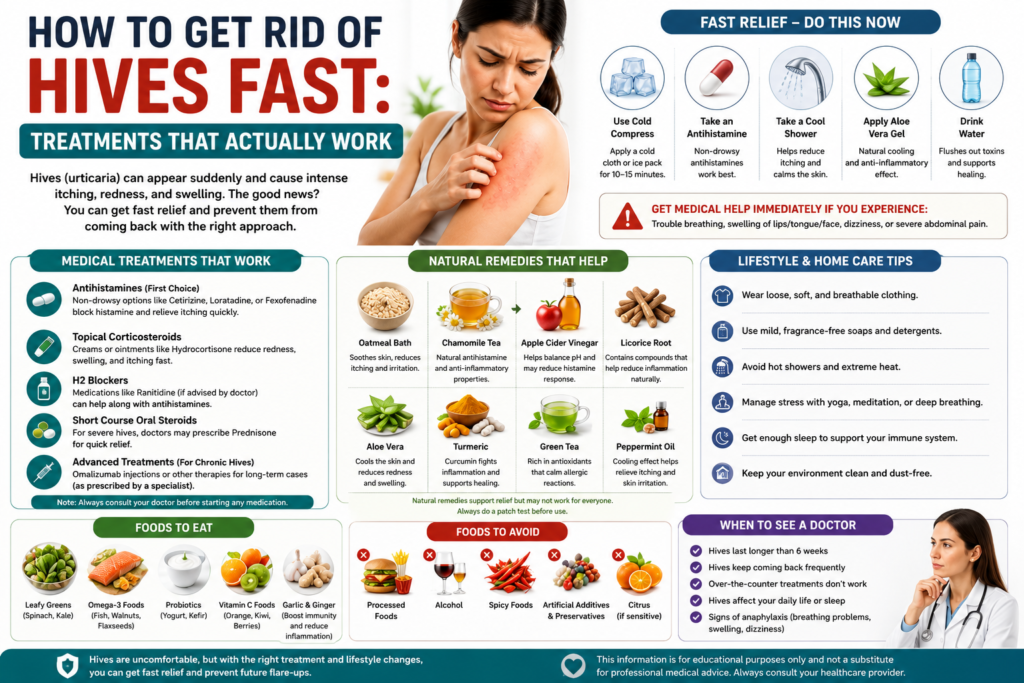
Herbal and Natural Remedies: What the Evidence Actually Shows
This is where honesty matters most. Herbal and nutritional approaches can be genuinely useful as supportive measures — they reduce discomfort, and a few have real research behind them. None of them is a cure, and none should replace medical treatment for severe or persistent hives.
Vitamin D
The strongest evidence in this category. A randomised controlled trial published in Annals of Allergy, Asthma & Immunology found that adding high-dose vitamin D3 to standard antihistamine therapy produced a significantly greater reduction in symptom scores in chronic urticaria patients than antihistamines alone. Vitamin D appears to influence mast cell behaviour and immune regulation.
Practical note: ask your doctor to check your level before supplementing at high doses. Vitamin D is fat-soluble and accumulates.
Quercetin
A plant flavonoid found in onions, apples, capers, and green tea. Laboratory and animal studies show it stabilises mast cells and reduces histamine release, and it is one of the more biologically plausible options. Human trials specifically in urticaria are still small and limited, so the honest verdict is promising but unproven.
Safety: may interact with blood thinners and some antibiotics.
Colloidal oatmeal
Well-supported for itch relief in inflammatory skin conditions generally, thanks to compounds called avenanthramides that have anti-inflammatory and barrier-supporting effects. It does not stop hives from forming, but a lukewarm colloidal oatmeal bath provides real, immediate comfort. Low risk, easy to try.
Aloe vera
Soothing and cooling when applied topically to unbroken skin. The relief is largely symptomatic rather than anti-histaminic. Use pure gel without added fragrance or alcohol, and patch-test first — aloe allergy exists.
Stinging nettle
Traditional Western herbalism uses freeze-dried nettle leaf for allergic conditions, and there is modest trial evidence in allergic rhinitis. Evidence specific to urticaria is essentially absent. Traditional use is real; scientific confirmation is not there yet.
Safety: may affect blood pressure and blood sugar; avoid in pregnancy without medical advice.
Chamomile
Anti-inflammatory compounds make it a reasonable topical soothing agent as a cooled compress. Important caution: chamomile is in the same botanical family as ragweed, and people with that allergy can react badly to it.
Turmeric and curcumin
Genuine anti-inflammatory activity in the lab, but curcumin is poorly absorbed orally and human evidence in urticaria is lacking. Consider it a general anti-inflammatory food rather than a hives treatment.
Safety: high doses can increase bleeding risk and irritate the stomach.
Probiotics
Small studies in chronic urticaria have produced mixed results. Plausible mechanism through gut immune regulation, insufficient evidence for a firm recommendation.
What to be sceptical of
Be wary of any product promising to cure hives permanently, any “detox” protocol claiming to flush out the cause, and undisclosed herbal blends — some imported preparations sold for skin conditions have been found to contain unlabelled corticosteroids. If a remedy works dramatically and immediately, ask what is actually in it.
Home Care Tips That Make a Real Difference
- Apply cool, not cold. A cool damp cloth for 10–15 minutes calms itch by dampening nerve signalling. Skip ice packs unless you have ruled out cold urticaria, where cold makes things dramatically worse.
- Lower the water temperature. Hot showers are one of the most common self-inflicted flare triggers. Lukewarm, and keep it brief.
- Wear loose cotton. Friction and heat under tight synthetic fabric drive welts, particularly at waistbands and straps.
- Keep the bedroom cool. Around 18°C, with light bedding. Most people itch worst at night.
- Moisturise with a plain fragrance-free emollient after bathing, applied to slightly damp skin.
- Trim your fingernails short. Scratching physically triggers new welts in anyone with a dermographic tendency, creating a self-sustaining loop.
- Use a distraction technique for itch. Firm pressure or a cool cloth interrupts the itch signal without the skin trauma of scratching.
- Photograph your welts. They routinely vanish before your appointment. Timestamped photos are genuinely useful diagnostic evidence.
Foods to Eat and Foods to Avoid
An important qualifier first: unless you have a confirmed food allergy, diet is a secondary factor in hives, not the main lever. Restrictive elimination diets adopted without medical guidance cause nutritional gaps and considerable anxiety for uncertain benefit.
That said, a subset of people with chronic urticaria improve on a diet low in histamine and food additives. European studies of pseudoallergen-free diets show meaningful improvement in a minority of patients — worth a supervised three-week trial if standard treatment is falling short, but not something to commit to indefinitely without a clear result.
| Generally well tolerated | Worth reducing during a flare |
|---|---|
| Fresh meat, poultry, and fresh-caught fish | Aged cheeses, cured and processed meats |
| Rice, oats, quinoa | Fermented foods — sauerkraut, kimchi, soy sauce, vinegar |
| Most fresh vegetables | Tomatoes, spinach, aubergine, avocado |
| Apples, pears, blueberries, mango | Strawberries, citrus, pineapple |
| Olive oil, fresh herbs | Alcohol, especially red wine and beer |
| Eggs (if not allergic) | Leftovers stored more than 24 hours |
| Water, herbal teas | Artificial colours, benzoate preservatives, MSG |
Two additions worth making rather than removing: oily fish two or three times a week for omega-3 fatty acids, and quercetin-rich foods such as onions, apples, and capers.
Alcohol deserves a specific mention. It dilates blood vessels, raises skin temperature, disrupts sleep, and is one of the most consistently reported flare triggers people identify on their own.
Prevention Tips
- Keep a trigger diary for at least a month. Patterns emerge from data, not memory.
- Treat through the flare, not just the bad days. Consistent daily antihistamine dosing prevents welts far better than reactive dosing.
- Avoid NSAIDs if they aggravate you. Paracetamol is usually the safer analgesic in that situation — confirm with your doctor.
- Warm up gradually before exercise if heat sets you off, and cool down promptly afterwards.
- Protect against cold with gloves and layers if cold triggers your hives, and never swim alone in cold water — cold urticaria can cause serious systemic reactions.
- Build in stress management that you will actually maintain. Regular sleep, moderate exercise, and breathing practice all reduce flare frequency in practice.
- Simplify your skincare. Fragrance-free, minimal ingredients, no exfoliating acids during active flares.
- Carry your epinephrine auto-injector if one has been prescribed, and make sure someone close to you knows how to use it.
When to See a Doctor
Book an appointment if:
- Hives have persisted beyond six weeks
- Itching is disrupting your sleep or daily functioning
- Individual welts last more than 24 hours, hurt, or leave bruising
- Hives are accompanied by fever, joint pain, or weight loss
- They appeared shortly after starting a new medication
- Over-the-counter antihistamines are not controlling symptoms
- You have recurrent swelling of the lips or eyelids
- The affected person is an infant or very young child — see our guidance on hives in babies and toddlers
Seek emergency care immediately for breathing difficulty, throat tightness, tongue or mouth swelling, hoarseness, dizziness, fainting, or hives spreading rapidly with vomiting. Detailed guidance on when widespread outbreaks warrant urgent assessment is available in our article on hives all over the body.
Final Thoughts
Most hives resolve on their own within days to weeks, and a regular non-drowsy antihistamine handles the majority of cases comfortably. That is genuinely reassuring, and worth holding onto during the first alarming outbreak.
For the smaller group whose hives settle in for months, the picture is different but far from hopeless. Chronic urticaria is a well-mapped condition with a clear, escalating treatment pathway, and the newer biologic options have transformed outcomes for people who previously had none. The frustration in these cases is usually not that treatment fails — it is that people stop at over-the-counter doses and never progress to the next step.
Natural and herbal approaches have a legitimate supporting role. Vitamin D repletion has real trial evidence behind it. Colloidal oatmeal and cool compresses provide genuine comfort. Quercetin is biologically plausible and worth watching. What none of them do is replace proper medical assessment when hives are severe, persistent, or accompanied by swelling — and any source telling you otherwise is not being straight with you.
If you take one practical step away from this article: start the symptom diary today. It costs nothing, and it is the single piece of information that most often unlocks the diagnosis.
Medical disclaimer: This article is for general information and is not a substitute for professional medical advice, diagnosis, or treatment. Always consult a qualified healthcare provider about your individual circumstances, particularly before starting any supplement or stopping any prescribed medication.
Frequently Asked Questions
How long do hives on skin usually last? Individual welts typically fade within 24 hours, often in just a few hours. A full acute episode usually clears within a few days to a few weeks. When outbreaks continue for six weeks or longer, the condition is classed as chronic urticaria.
Are hives contagious? No. Hives are an internal immune reaction in your own skin and cannot spread from person to person by touch or contact. If a virus triggered them, the virus may be contagious — the hives themselves are not.
Why do my hives get worse at night? Several factors converge in the evening: natural cortisol levels fall, body temperature rises under bedding, there are fewer distractions competing with the itch signal, and antihistamines taken in the morning are wearing off. Taking a long-acting antihistamine in the evening, with a cool bedroom, usually helps.
Can stress alone cause hives? Stress rarely creates hives from nothing, but it lowers the threshold at which your mast cells release histamine and worsens the itch–scratch cycle. Many people with chronic urticaria see clear flares during high-stress periods.
Should I get allergy testing for hives? Only if your history points to a specific exposure — a food that repeatedly causes welts within two hours, an insect sting, or a new medication. Broad untargeted allergy panels frequently produce incidental positives that lead to unnecessary avoidance without improving symptoms.
What is the ICD-10 code for hives? Urticaria falls under L50, with subcodes including L50.0 for allergic urticaria, L50.1 for idiopathic urticaria, L50.2 for urticaria due to cold or heat, and L50.9 for unspecified urticaria.
Do natural remedies work for hives? Some help meaningfully as supportive care. Vitamin D supplementation has randomised trial evidence as an add-on therapy, and colloidal oatmeal baths reliably reduce itch. Quercetin is plausible but under-studied in humans. None of these replaces antihistamines or specialist treatment for severe or chronic hives.
When are hives a medical emergency? When they occur alongside difficulty breathing, throat tightness, swelling of the tongue or mouth, hoarseness, dizziness, fainting, or vomiting. These signal anaphylaxis and require emergency treatment immediately — use an epinephrine auto-injector if you have one, then call emergency services.